Black
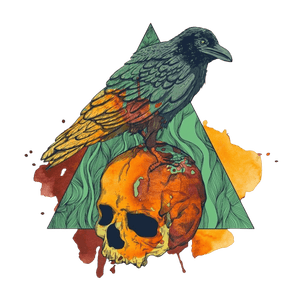
crow shown in profile facing right, standing atop a cracked orange skull with
deep black eye sockets. the crow’s feathers are layered in dark blue-black with
green undertones, transitioning to muted yellow and olive feathers along the
wing. behind the bird and skull sits a green triangle filled with flowing, wavy
line patterns. watercolor-like orange and rust splashes spread outward beneath
and around the skull, with drips trailing downward. this artwork is titled
“Crow” and created by Jess Adams
You
drift first into the crow itself. The bird dominates the upper half of the
composition, perched solidly and confidently, its body angled slightly forward.
Feathers are built in overlapping rows, each one individually outlined,
creating a dense, armored texture across the chest and back. The head is
compact and alert, beak closed, eye small and sharp, set into the dark mass of
the face. Subtle green and blue tones move through the black plumage, catching
light along the feather edges and preventing the form from flattening into
silhouette.
Your
eye follows the crow downward to where its talons grip the skull beneath it.
The skull is rendered in warm oranges and yellows, visibly cracked and uneven,
with hollow eye sockets carved deep into its face. Ink lines carve structure
into the bone, while watercolor washes bleed outward, forming irregular edges
and drips that extend below the jaw. These drips pull gravity into the image,
grounding the skull’s weight and anchoring the crow’s stillness above it. The
contrast between the bird’s controlled linework and the skull’s fluid color
gives the composition tension without chaos.
Behind
both forms, a green triangle rises, its surface filled with rhythmic, flowing
lines that resemble layered strands or carved grooves. The triangle’s edges are
clean and deliberate, acting as a stabilizing frame. The crow’s back overlaps
its top edge, breaking the geometry just enough to keep the image alive. The
triangle does not recede; it presses forward, flattening space and holding the
crow and skull in a single visual plane. Around this structure, orange and rust
washes bloom outward, soft-edged and organic, their irregular shapes echoing
the skull’s fractured surface.
Stillness
becomes the defining emotional note. The crow does not attack or flee; it
waits. The skull does not crumble further; it remains intact despite its
fractures. Every element feels paused mid-breath. Line density increases where
weight rests — beneath the crow’s feet, along the skull’s brow — while lighter,
quicker strokes appear in the feathers’ outer edges and the triangle’s flowing
interior lines. The image holds tension through balance rather than motion,
allowing presence to outweigh action.
On
stonewashed denim, the orange skull immediately softens. Pigment sinks into the
worn twill, blurring the edges of cracks and allowing the watercolor drips to
feather outward. The skull feels older here, less sharp, its contours absorbed
by the fabric’s memory. Emotionally, this shifts the piece toward quiet
endurance, as if the skull has weathered time rather than met sudden force.
The
crow on stonewash becomes slightly less severe. The dark feather lines lose
some crispness, blending into one another as the denim texture interrupts fine
detail. Green undertones surface more gently, and the bird feels integrated
into the garment rather than imposed upon it. The overall mood becomes
contemplative and worn-in, emphasizing patience and still presence.
On
white denim, everything sharpens. The crow’s feather structure becomes precise
and highly readable, each layered row clearly separated. The eye and beak stand
out with graphic clarity, and the bird feels alert and intentional. The skull’s
cracks appear more pronounced, the orange wash contained rather than bleeding,
giving the bone a defined, illustrated firmness.
The
green triangle on white denim becomes a strong visual anchor. Its internal
linework reads cleanly, reinforcing the geometry behind the organic forms.
Emotionally, this version feels declarative and bold — the crow stands as a
clear focal point, the skull as a deliberate base, with no visual ambiguity.
On
black denim, the artwork compresses into depth. The crow’s body blends closely
with the dark fabric, allowing highlights and green-blue undertones to emerge
selectively along feather edges. The bird feels closer, quieter, and more
internal, as if seen in low light. The skull’s orange glows against the black,
pulling attention downward and creating a dramatic contrast.
The
triangle and watercolor splashes on black denim recede slightly, becoming
atmospheric rather than structural. Drips feel heavier, more cinematic, and the
entire composition gains intimacy. Emotionally, this version carries weight and
restraint — the crow’s stillness feels intentional and guarded, held close to
the body rather than displayed outward.