A
richly colored symmetrical dark butterfly with wide outstretched wings rendered
in deep burgundy, chocolate brown, and smoky violet tones. large iridescent
blue and purple eyespots sit near the lower wings, with smaller multicolored
markings near the upper edges. A soft lavender glow surrounds the wings against
a white background, and the butterfly’s body is centered with fine antennae
extending upward. this artwork is titled “Ashwood Damask Butterfly” and created
by Brigid Ashwood
You
drift first into the stillness of the wings, spread wide and perfectly
balanced, their edges hovering inside a faint lavender haze. The butterfly does
not appear mid-flight or mid-rest — it exists in a suspended state, as if time
has paused specifically to allow the pattern to be seen. The body runs straight
and centered, dividing the composition with quiet authority, while the wings
breathe outward in mirrored symmetry.
Your
eye is immediately drawn to the eyespots along the lower wings. Each one is
dense and luminous, layered with deep sapphire blues and violet cores
surrounded by warm rings of amber and charcoal. The pigment thickens slightly
at the edges of these forms, creating subtle halos where color transitions slow
down instead of stopping abruptly. On denim, these halos sink into the twill,
breaking into microscopic valleys of light and shadow. It matters because the
eyespots stop feeling decorative and begin to feel watchful — as if awareness
itself has been embedded into the wings.
A
shift in mood happens as you move upward along the wings. The upper sections
deepen into velvety maroons and browns, with soft gradients that suggest
layered feathering rather than flat surface. Brush direction flows outward from
the body, reinforcing the sense that the butterfly expands from a central
pulse. Near the upper corners, small iridescent accents flash faint hints of
magenta and gold. These highlights catch differently depending on angle, and on
denim they fracture slightly, creating a slow shimmer rather than a shine. The
wings feel alive — not moving, but capable of movement.
Then
comes a new kind of quiet at the body. The thorax is darker, more compressed,
with subtle texture that reads almost furred rather than smooth. The antennae
rise delicately, thin and precise, their tips fading into the surrounding glow.
On fabric, these fine lines soften at the edges, making them feel atmospheric
rather than sharp. The body becomes an anchor — a point of gravity holding the
vast wings steady.
Color
becomes emotion in the interplay between darkness and glow. The wings are heavy
with pigment, rich and saturated, yet they are surrounded by a pale violet aura
that lifts them from the background. This contrast creates tension without
conflict — weight held inside light. The butterfly feels ceremonial, as though
it exists not in nature alone but in myth, memory, and pattern simultaneously.
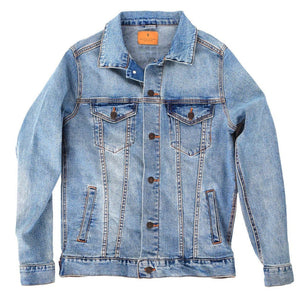
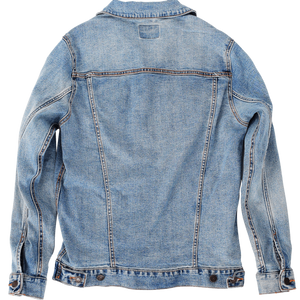
When
this artwork lives on stonewashed denim, the darker pigments soften and spread
gently into the weave. The edges of the wings blur slightly, allowing the
lavender glow to expand and feel more atmospheric. The eyespots lose a hint of
sharpness, becoming more mysterious and dreamlike. As the jacket moves, light
breaks unevenly across the saturated wings, giving the illusion of slow,
internal motion — transformation unfolding quietly over time.
On
stonewash, the butterfly feels ancient and familiar, like a symbol rediscovered
rather than newly seen. The texture of the denim amplifies the organic quality
of the wings, making the artwork feel worn-in, protective, and talismanic.
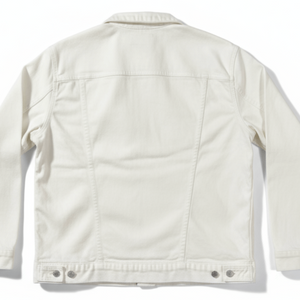
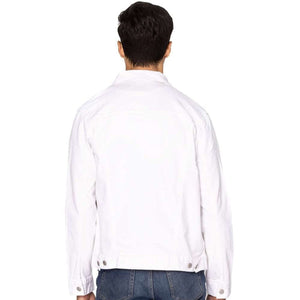
On
white denim, clarity takes hold. The symmetry becomes striking, and every color
separation reads cleanly. The eyespots intensify, their blues and purples
becoming more luminous against the bright base. Fine gradients along the wings
are easier to trace, revealing the careful layering of pigment. This clarity
matters because it shifts the butterfly’s presence toward alertness — beauty
that watches back.
The
lavender glow remains contained on white denim, acting as a precise aura rather
than a mist. The artwork feels ceremonial and intentional, like a symbol placed
with purpose rather than chance.
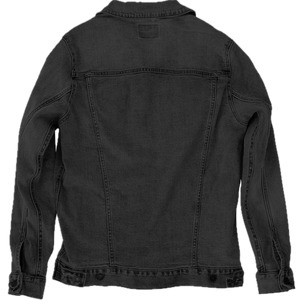
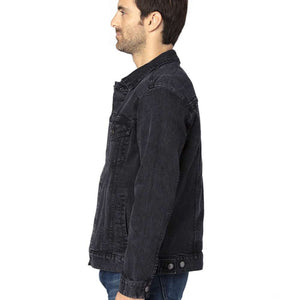
On
black denim, the scene deepens dramatically. The wings compress into rich
shadow, and the eyespots emerge as glowing focal points, almost jewel-like
against the dark base. The butterfly feels heavier, more powerful, its symmetry
commanding attention. The glow around the wings becomes subtle but potent,
appearing and disappearing as the fabric folds.
On
black denim, the butterfly reads as protection and transformation combined — a
presence carried close to the body. The darkness intensifies its mystery, and
the eyes seem to hold knowledge rather than decoration. The artwork feels less
like an image and more like an emblem — something worn not just for beauty, but
for meaning.