Large symmetrical butterfly centered on a deep purple damask-patterned background. the butterfly has broad wings in rich brown, rust, and plum tones with iridescent blue and violet eye spots near the lower wings and smaller reflective highlights near the upper edges. the body is dark and softly textured, with thin antennae extending upward. a faint violet glow surrounds the wings, separating the butterfly from the patterned backdrop. this artwork is titled “Ashwood Damask Butterfly background” and created by Brigid Ashwood
The composition is built entirely on symmetry. The butterfly is centered precisely, wings spread wide and level, each side mirroring the other in shape, color placement, and weight. The upper wings taper outward with smooth, rounded edges, while the lower wings widen and curve downward, forming a soft, scalloped silhouette. The body runs straight up the center, anchoring the balance with quiet authority.
Color becomes the first point of engagement. The wings are layered in warm browns, deep russet, and muted plum, with transitions that feel brushed rather than blended. Near the lower wings, large eye-like markings glow in saturated blues and violets, ringed by softer halos of amber and gold. These markings are not flat; they appear luminous, as if light is caught beneath the surface of the wing. Smaller reflective highlights near the upper wings echo this glow, creating visual rhythm without repetition.
Texture deepens the form. The wing surfaces show subtle grain and painterly variation, with darker shading along the veins and edges that adds depth without harsh contrast. The butterfly’s body is darker and velvety, its surface absorbing light rather than reflecting it. Thin antennae rise upward, delicate and restrained, completing the vertical axis.
Behind the butterfly, the background holds steady. A deep violet field is patterned with an ornate damask motif, symmetrical and continuous. The pattern is slightly lighter than the base color, visible but never dominant. It frames the butterfly without enclosing it, allowing the central figure to remain visually separate. A soft lavender glow radiates outward from the wings, gently lifting the butterfly off the background and preventing the composition from flattening.
Nothing in the scene suggests motion. The butterfly does not flutter or tilt. It exists in a moment of perfect stillness, suspended between presence and ornament. The symmetry, glow, and pattern combine to give the image a ceremonial quality rather than a naturalistic one.
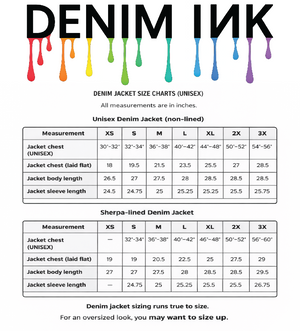
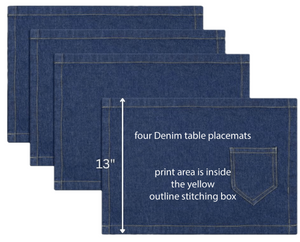
On stonewashed denim, the butterfly’s glow softens and spreads. The violet background diffuses into the fabric grain, and the damask pattern becomes more atmospheric, like a memory of pattern rather than a strict design. The blue eye spots deepen and mellow, losing sharp edges while retaining their depth. Emotionally, the piece feels intimate and antique, like a textile-inspired relic worn smooth over time.
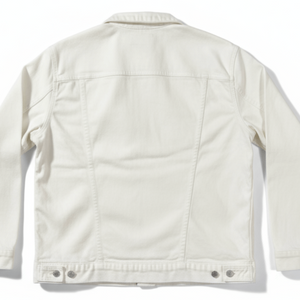
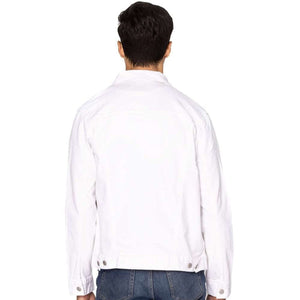
On white denim, contrast sharpens. The butterfly’s silhouette becomes crisp, and the warm browns and plums stand out clearly against the bright base. The eye spots read vividly, their blues and purples clean and luminous. The damask pattern becomes more legible, reinforcing structure and symmetry. Emotionally, the artwork feels refined and decorative, like a formal emblem or gallery print.
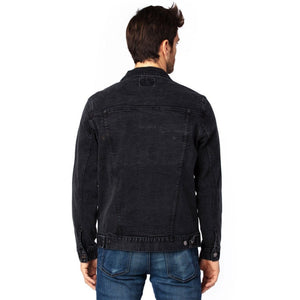
On black denim, the butterfly becomes dramatic and jewel-like. The background disappears into darkness, allowing the wings and glowing eye spots to intensify. The violet halo feels stronger, and the symmetry becomes commanding. Emotionally, the piece transforms into a nocturnal icon — elegant, mysterious, and self-contained — where stillness and presence hold equal power.