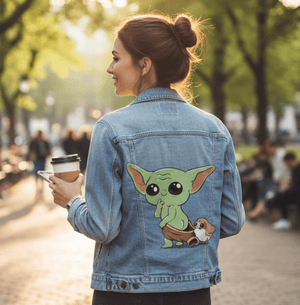
A
small green childlike figure with oversized pointed ears & large glossy
black eyes standing slightly turned, one hand raised to its mouth in a shy
gesture. The figure wears loose brown pants pooling at the ankles. behind it, a
tiny round bird-like creature with tan wings, a white belly, & wide dark
eyes peeks out. Thick black outlines,
muted green & brown tones, & halftone-style texture define the forms
against a transparent background. "Baby Yoda and Porg" by Pepe Rodriguez aka ppmid
You
drift first into the figure’s scale. The green character fills the frame with
an almost bobble-headed proportion, ears stretching wide to the left and right,
their tips angling slightly upward. The head is large and rounded, with three
shallow crease lines arcing across the forehead. The eyes dominate the face,
nearly circular and rendered in deep black with bright white highlights that
sit high and slightly off-center, giving them a wet, reflective presence. The
mouth is small and curved into a quiet smile, placed low on the face, leaving a
wide field of green skin above it.
Your
eye drops to the body, where the pose introduces a gentle tension. One hand
lifts toward the mouth, fingers curved inward, creating a soft diagonal that
breaks the otherwise upright stance. The other arm hangs lower, bent slightly
at the elbow. The torso is compact, the legs short, ending in bare green feet
planted close together. The brown pants are oversized, gathered loosely around
the waist and sagging at the hips, with folds that bunch and overlap in thick,
rounded shapes. The fabric looks heavy relative to the small body, emphasized
by dark contour lines and shaded interiors.
Then
comes the second presence, half-hidden and quietly insistent. At the lower
right, the small bird-like creature emerges from behind the pants, its round
body pressed close. Its head tilts upward, eyes wide and glossy, mirroring the
reflective quality of the larger figure’s gaze. The wings curve outward and
back, tan with darker edging, while the belly is a clean, pale white that
contrasts sharply against the brown fabric. Its feet are barely visible, tucked
beneath the body, reinforcing its tucked-in, companionable position.
A
shift in mood happens when you notice how the outlines behave. Thick black
lines define every edge, but they vary slightly in width, thickening around the
ears, pants folds, and wing curves. Inside those lines, color is flat but
textured, with subtle dot patterns and grain that suggest printed ink rather
than smooth paint. Shadows are simplified into darker blocks of green and
brown, placed consistently beneath the chin, along the pant folds, and under
the bird’s belly, grounding both figures without anchoring them to a detailed
environment.
The
absence of a background matters. With no setting, no horizon, and no props
beyond the shared fabric, the focus collapses inward onto gesture and
proximity. The raised hand, the shared pants, the close spacing between bodies
all become the scene. The composition feels contained, self-sufficient, as if
the moment exists only for itself, suspended without time or place.
On
stonewashed denim, the soft grain of the fabric immediately diffuses the clean
edges of the green skin, especially along the ears and rounded head. Pigment
sinks into the worn twill, blurring the halftone texture so the forehead
creases and cheek shading feel gently aged. The emotional tone shifts toward
nostalgia, as if the figures have always lived there, absorbed into the jacket
over years of wear.
The
brown pants benefit from the stonewash most clearly. Their darker blocks of
color spread slightly, softening the contrast between fold and shadow. The
bird’s white belly loses its sharpness and becomes warmer, closer to cream,
which pulls the companion closer emotionally. The shared fabric reads as
comfort rather than weight.
Overall,
stonewashed denim turns the scene into memory. The figures feel less like a
crisp illustration and more like a familiar image rediscovered, their closeness
emphasized by the way edges relax and blend into the cloth.
On
white denim, everything sharpens. The green skin reads clean and bright, with
the black outlines snapping into focus. The eye highlights become more
pronounced, pulling attention immediately to the faces. The raised hand and
small smile feel more intentional, more clearly defined as a gesture.
The
brown pants contrast strongly against the white base, making every fold
legible. The bird’s pale belly becomes crisp and luminous, separating clearly
from the surrounding fabric. Halftone textures stand out instead of dissolving,
reminding you of the illustration’s printed origins.
Emotionally,
white denim makes the artwork feel present and declarative. The figures are no
longer remembered; they are announced. Their closeness reads as playful and
intentional, held in clear light rather than softened by time.
On
black denim, the scene compresses inward. The green skin glows against the dark
base, especially along the ears and cheeks, where lighter pigment floats atop
the fabric. Shadows deepen, and the outlines feel heavier, enclosing the
figures more tightly.
The
pants merge more subtly into the background, causing the shared fabric to feel
enveloping. The bird’s white belly becomes a focal point, a small bright oval
emerging from darkness. The eyes, both large and small, feel closer and more
intimate as their highlights contrast sharply with the black ground.
Here,
the emotion turns cinematic. The figures feel protected by shadow, their quiet
companionship intensified. Black denim transforms the illustration into a
contained, intimate moment, as if you’ve stepped closer and lowered your voice
to be part of it.