An
abstract black and white composition formed by swirling, marbled paint-like
waves. Soft white areas blend into charcoal and deep black shapes with fluid,
irregular edges. thin gray lines and ripples trace through the forms, while
small speckled dots appear in scattered clusters. The overall shape is organic
and asymmetrical, floating against a black background. This artwork is titled
“Black and White Waves” and created by RaMir Designs
You
drift first into the motion, because nothing here stands still. Broad white
regions surge forward, then thin abruptly into gray, then collapse into deep
black pools. The transitions are fluid, not layered by line but by flow, as if
pigment was poured and gently pulled across the surface. Edges are uneven and
breathing, sometimes feathered into mist, sometimes snapping into sharper
boundaries where darker tones push back.
Your
eye follows the currents as they bend and fold. Black shapes stretch like
slow-moving shadows, curving inward and then releasing, never forming straight
paths. Pale gray ribbons snake between light and dark, acting as quiet
intermediaries. In places, the paint appears dragged into thin striations,
creating subtle ripples that suggest directional force without pointing to a
source.
A
shift in sensation happens when you notice the speckling. Small clusters of
dots appear irregularly, most visible where white meets black. They are not
evenly distributed; some areas are dense, others nearly empty. The speckles
feel incidental, like residue left behind after movement, reinforcing the sense
that this image records a process rather than a fixed design.
The
composition has no center. Instead, weight shifts constantly as the eye moves,
pulled from a heavy black mass in the lower left toward lighter, more open
white forms near the top and edges. The overall silhouette is organic and
asymmetrical, with portions thinning into wisps that dissolve into the
surrounding black background. There is no frame, only the suggestion that the
image could continue beyond its visible edges.
Materially,
the surface reads as liquid transformed into stillness. The marbling effect
shows layers interacting — white pushing through black, black bleeding into
white — with gray forming wherever the two hesitate. There are no outlines.
Form exists entirely through contrast and flow.
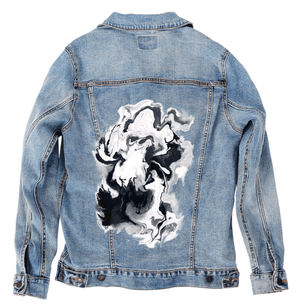
On
stonewashed denim, the boundaries soften further. White areas sink into the
worn twill, losing some brightness and becoming creamy and atmospheric. Black
regions diffuse into charcoal, especially along their edges, where the denim’s
grain breaks the smoothness of the paint-like flow.
The
gray ripples blend naturally with the fabric texture, making the entire
composition feel quieter and more cohesive. Speckled dots embed into the denim
weave, reading less as distinct marks and more as part of the material itself.
Emotionally, the piece shifts toward calm and memory — motion slowed and
absorbed.
Stonewashed
denim makes the artwork feel like weathered movement. The waves become gentle,
their energy dispersed, as if time has softened their force.
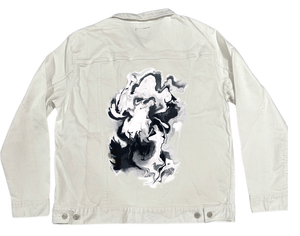
On
white denim, clarity sharpens the contrast. Whites appear clean and expansive,
while blacks regain depth and authority. The marbled boundaries become more
legible, allowing the eye to trace individual flows and eddies with precision.
Gray
lines and ripples stand out distinctly, emphasizing the layered nature of the
motion. Speckling reads crisply, punctuating the surface with intentional
texture. Emotionally, white denim presents the artwork as active and present —
a moment of motion held at peak visibility.
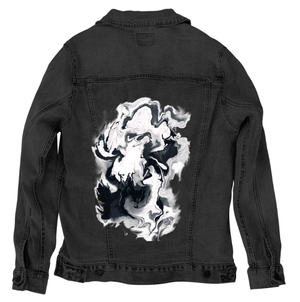
On
black denim, the composition compresses inward. Black areas merge partially
with the base fabric, causing white regions to glow more strongly. The image
feels carved out of darkness rather than placed upon it.
Gray
transitions become subtle and intimate, visible only where pigment rises above
the weave. Speckling nearly disappears, leaving only faint hints of texture.
Emotionally, black denim turns the piece inward and contemplative. The waves
feel internal, like movement beneath the surface, held close and quiet rather
than expansive.