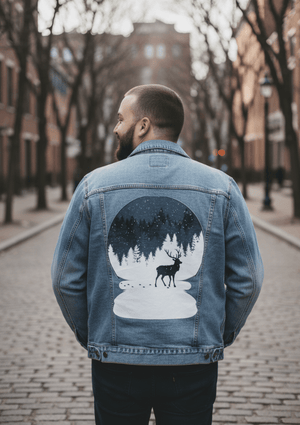
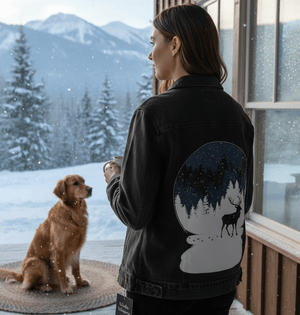
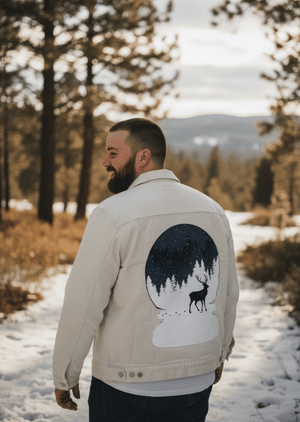
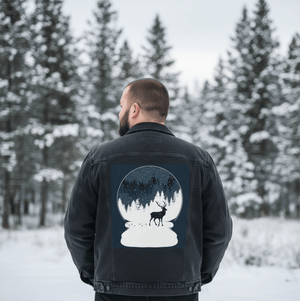
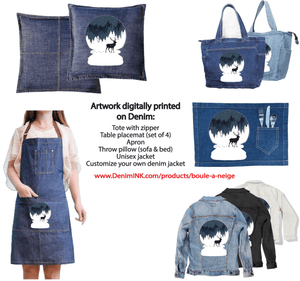
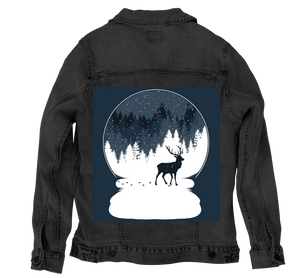
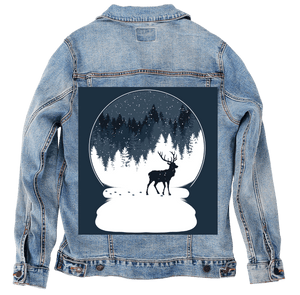
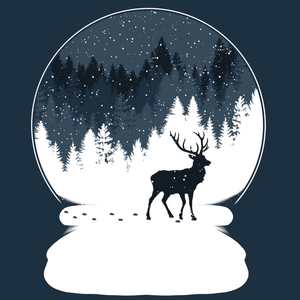
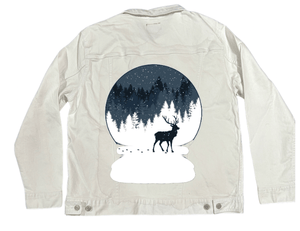
A snow globe containing a winter forest scene with layered evergreen trees in dark blue and charcoal tones. white snow falls throughout the globe as small round dots. A black silhouette of a stag with large branching antlers stands at right on a snowy ground, with a line of hoof prints trailing behind it. The snow globe has a clear circular dome and a solid white base, set against a black background. This artwork is titled “Boule à Neige” and created by Tobe Fonseca
As you gaze into the stillness everything here is paused mid-fall. Snow dots the interior of the globe evenly, small white circles suspended against deep blue and charcoal layers of forest. The flakes do not streak or blur; they hover, as if time has stopped the moment after the globe was shaken. The circular glass edge frames the scene cleanly, creating a contained world that feels separate from everything beyond it.
Your eye settles on the trees. Evergreen silhouettes stack upward in layers, darker and denser at the top, lighter and more spaced toward the middle. Each tree is simplified into tapered forms with soft, feathered edges, creating depth through overlap rather than detail. The forest recedes naturally, its darkest shapes forming a night sky while lighter tree shapes suggest snowfall catching on branches.
Then the stag appears. Positioned slightly right of center, its body is rendered as a solid black silhouette, legs slender and straight, head lifted just enough to show alertness without motion. The antlers rise in wide branching arcs, their negative space carving delicate shapes out of the snowy background. No fur texture is shown—only form—making the animal feel iconic rather than literal.
At the stag’s feet, the ground becomes a quiet story. A short line of hoof prints trails behind it, each oval indentation spaced evenly, moving from left toward the figure. The snow beneath is smooth and uninterrupted elsewhere, emphasizing that this is the only recent movement inside the globe. The ground curves gently upward at the edges, reinforcing the illusion of depth within the sphere.
A shift in perception happens when you notice the base. The globe rests on a solid white pedestal, simplified and rounded, with no ornamentation. It mirrors the snow inside, visually grounding the scene while separating it from the darkness outside. The background beyond the globe is completely black, making the glass edge and interior glow subtly by contrast.
The illustration style is restrained and graphic. There are no gradients in the stag, no outlines on the trees, no reflections on the glass beyond the implied curve. Everything relies on contrast, spacing, and shape. The result is quiet and deliberate, like a winter moment held carefully in the palm of a hand.
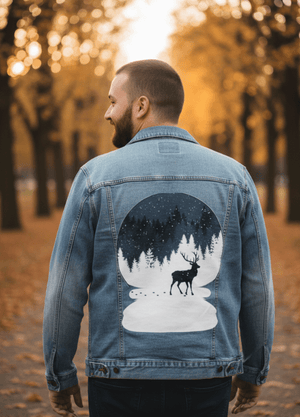
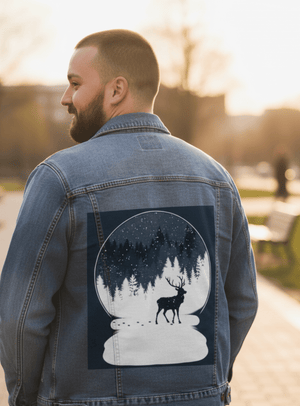
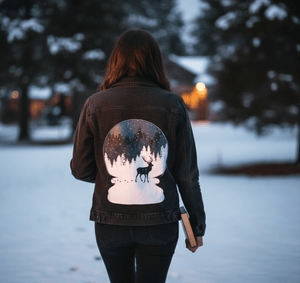
On stonewashed denim, the scene softens into memory. The dark blue forest layers diffuse into the worn twill, blurring the separation between tree silhouettes. Snow dots embed into the fabric grain, becoming texture rather than falling flakes. The stag’s silhouette softens slightly at the edges, feeling less sharp and more atmospheric.
The white snow and globe base warm toward off-white on stonewash, blending naturally with the denim’s faded highlights. Emotionally, the piece shifts toward nostalgia—like a snow globe remembered from childhood rather than freshly shaken.
Stonewashed denim makes Boule à Neige feel gentle and familiar. The stillness becomes comforting, the winter scene worn into the fabric like a long-held quiet thought.
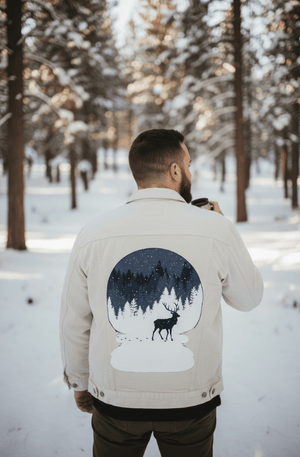
On white denim, clarity takes hold immediately. The contrast between forest layers sharpens, making each tree silhouette distinct. The snow dots become crisp and evenly spaced, reinforcing the suspended motion. The stag’s antlers read cleanly, their branching structure precise and graphic.
The globe’s circular edge and base become more architectural, clearly defining the contained world. Emotionally, white denim presents the artwork as pristine and serene—a clean winter vignette held in perfect balance.
On black denim, the composition becomes intimate and nocturnal. The forest merges partially with the base fabric, causing the lighter trees, snow, and stag silhouette to glow forward. The snow dots feel like stars, scattered through darkness.
The stag becomes the dominant presence, its silhouette powerful and solitary. The globe feels less like an object and more like a window cut into night. Emotionally, black denim transforms Boule à Neige into a quiet, contemplative vision—winter reduced to essence, held close, where silence and form speak louder than detail.