A
bride seen from behind wearing a flowing white wedding dress, painted in
expressive, layered brushstrokes. the gown trails outward with long sweeping
strokes, creating a sense of movement across a textured ground. The bride’s
blonde hair falls in loose waves down her back, and she holds a bouquet of pale
flowers. architectural details and garden elements appear softly in the
background, rendered in blues, greens, reds, and pinks. This artwork is titled
“Bride” and created by Paige Flotterud
You
drift first into motion rather than form. The bride is centered but not static,
her body angled forward as if mid-step, the dress pulling behind her in wide,
confident strokes of white and cream. The paint is thick and directional,
dragged outward from her waist into long ribbons that skim the surface. These
strokes vary in opacity, some dense and opaque, others translucent enough to
reveal underlayers of blue, lavender, and warm gray beneath. The figure feels
present through movement rather than outline.
Your
eye rises to her upper body and hair. Loose blonde waves are suggested with
curved strokes of honey, cream, and soft brown, layered quickly and without
precision. The hair is not styled into neat strands; it flows in irregular arcs
that echo the motion of the dress. One arm lifts slightly, bent at the elbow,
holding a bouquet rendered in clustered pale marks — whites, soft greens, and
hints of lavender — pressed together without clear petal definition. The
bouquet reads as weight and texture rather than botanical detail.
A
shift in feeling happens as the setting emerges. Behind her, architectural
shapes — a porch railing, window frames, and garden elements — appear in
stacked strokes of blue, slate, red, and muted green. These forms are
suggested, not described, sitting firmly in the background without pulling
focus. The ground beneath her feet is a mosaic of color, layered with reds,
mauves, and blues, creating a sense of place without a clear surface. The
emotional pulse is anticipation held in grace — not ceremony, but transition,
captured mid-stride.
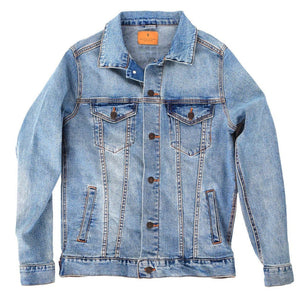
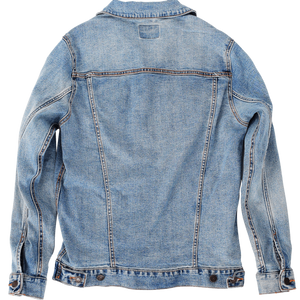
On
stonewashed denim, the white of the dress softens immediately. Pigment sinks
into the worn twill, blurring the long trailing strokes so they merge into a
single flowing mass. The dress feels lighter and more atmospheric, its edges
dissolving gently into the fabric. Emotionally, the moment shifts toward memory
— the motion recalled rather than unfolding.
The
background architecture on stonewash becomes quieter and more unified. Blues
and greens diffuse into the denim grain, reducing separation between structure
and ground. The bouquet softens into a pale cluster, less focal and more
symbolic. The bride feels less defined as a figure and more like an impression
passing through space.
As
a whole, the artwork on stonewashed denim feels tender and reflective. The
urgency of movement fades into calm continuity. The emotional tone becomes
nostalgic — a moment remembered softly, carried forward with warmth rather than
clarity.
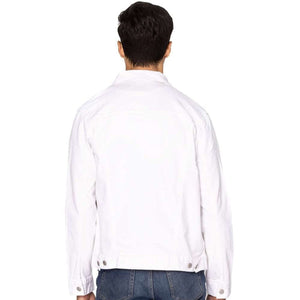
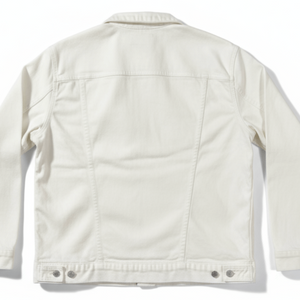
On
white denim, clarity takes control immediately. The sweeping strokes of the
dress become distinct again, each ribbon of paint clearly visible as it flows
outward. Whites brighten and cool slightly, restoring structure to the motion.
Emotionally, the bride feels present and luminous, caught in the act of
becoming.
Her
hair and bouquet sharpen on white denim. Individual strokes separate, and
subtle color variations become more readable. The background architecture gains
definition without overtaking the figure, reinforcing place while keeping the
bride dominant. The painterly texture feels intentional and confident.
Overall,
the artwork on white denim feels celebratory and open. The emotional shift is
toward clarity and affirmation — a moment of transition shown clearly, full of
light and forward motion.
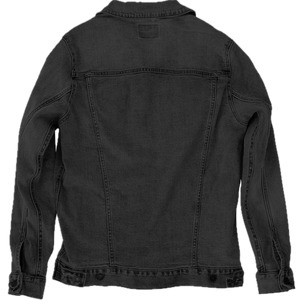
On
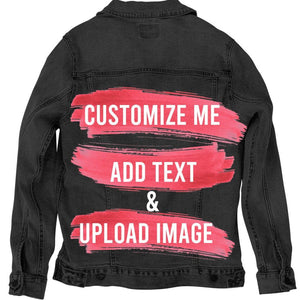
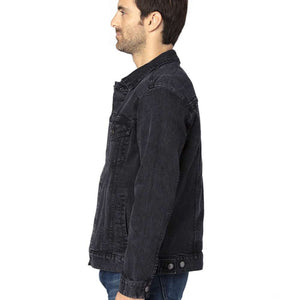
black denim, the composition compresses into intimacy. The white dress glows
against the dark base, its sweeping forms becoming the brightest and most
commanding element. The motion feels dramatic and close, as if the fabric is
moving directly toward the viewer. Emotionally, the bride feels powerful and
self-possessed.
The
background recedes almost entirely on black denim. Architectural details sink
into shadow, while the bouquet and highlights in the hair emerge as soft
accents. The figure stands alone within the movement of her dress, enclosed and
protected by darkness.
As a whole, the artwork on black denim feels cinematic
and inward. The transition becomes personal rather than public. The emotional
tone shifts toward quiet strength and intention — a bride moving forward, held
close, luminous against the dark