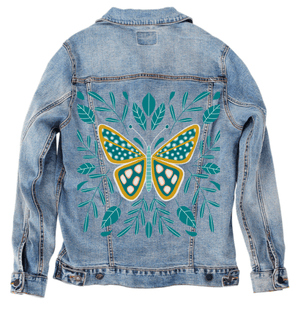
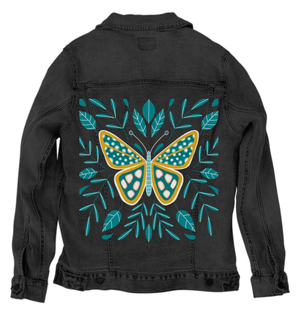
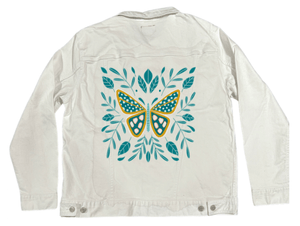
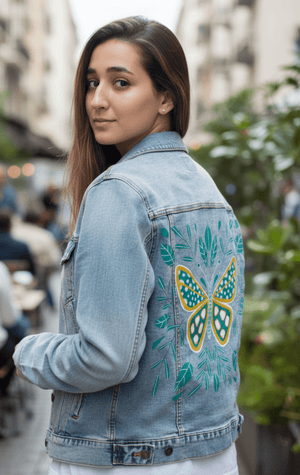
A symmetrical stylized butterfly centered on a transparent background, with teal wings outlined in mustard yellow and filled with white polka dots and pale peach oval markings. The butterfly has a segmented teal body with horizontal bands and thin antennae ending in small circles. Surrounding it is a circular wreath of teal leaves and branches with white veins, arranged evenly around the butterfly, with scattered white textured speckling behind the wings. This artwork is titled “Butterfly” and created by Hend Shehata
The butterfly holds the center with absolute stillness. Its body runs vertically through the composition, segmented into narrow horizontal bands that alternate subtly in tone, giving the impression of structure rather than softness. From this central spine, four wings extend outward in near-perfect symmetry. Each wing is bordered by a thick mustard-gold outline that contains the color like a frame, keeping the teal interior crisp and deliberate. The teal is not flat; it shifts slightly in density, darker near edges, lighter toward the center, revealing the hand of the brush.
Inside the wings, pattern takes control. The upper wings are dotted with evenly spaced white circles, each one clean-edged and uniform, floating within the teal field. The lower wings replace dots with rounded, irregular ovals in pale peach, set deeper into the color. These shapes are not mirrored perfectly, but they balance one another visually, creating rhythm rather than duplication. The butterfly’s antennae rise gently from the head, thin lines ending in small circular tips, delicate and precise.
Behind the butterfly, a wreath of foliage creates containment without crowding. Leaves radiate outward in a loose circular formation, each leaf painted in teal with a single white vein running through its center and smaller angled veins branching off. Some leaves are long and narrow, others broader and oval, arranged so that no two directions feel identical. The foliage feels intentional and measured, forming a halo that frames the butterfly without touching it.
A dusting of white speckled texture sits behind the butterfly’s wings, irregular and grainy, like dry brush or lifted pigment. It breaks the smoothness of the teal and gold, adding depth without becoming a background. The transparent negative space beyond allows the entire composition to breathe. Nothing presses inward. Everything is held in balance, suspended.
On stonewashed denim, the sharp geometry softens. The mustard outlines bleed slightly into the twill, losing some of their hard edge. The teal wings blur at their boundaries, especially around the white dots, which sink gently into the fabric. The butterfly feels less graphic and more organic.
The surrounding leaves on stonewashed denim become atmospheric. Their white veins diffuse, no longer crisp lines but pale impressions. Emotionally, the piece shifts toward quiet familiarity. The symmetry remains, but it feels worn in, like a motif that has lived on the fabric for years.
The speckled white texture blends into the denim grain, making the butterfly feel embedded rather than printed. The artwork becomes gentle, calm, and comforting, its precision softened by time.
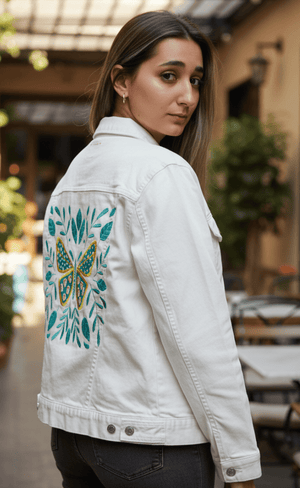
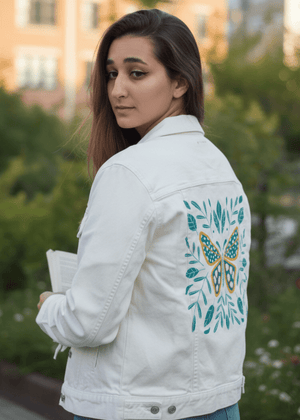
On white denim, clarity asserts itself immediately. Every edge sharpens: the mustard outlines snap into focus, the teal fields feel clean and bold, and the white dots and peach ovals stand out distinctly. The butterfly reads as graphic and intentional, its symmetry unmistakable.
The foliage wreath becomes crisp and decorative on white denim. Each leaf vein is clear, each branch defined, reinforcing the circular structure around the butterfly. Emotionally, the piece feels confident and declarative, like an emblem or crest.
This clarity gives the artwork presence. The butterfly feels light but strong, floating cleanly against the fabric. On white denim, the piece feels bright, polished, and contemporary.
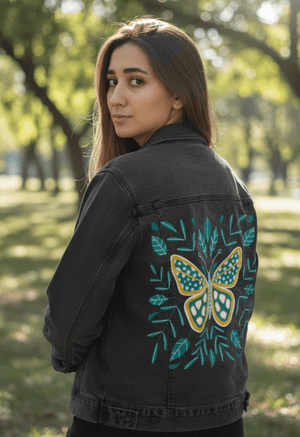
On black denim, the artwork compresses into intimacy. The teal wings deepen, becoming rich and saturated, while the mustard outlines glow warmly against the dark base. The white dots and peach ovals feel luminous, almost lit from within.
The foliage darkens significantly, with white veins glowing like etched lines in shadow. The speckled texture behind the wings becomes more pronounced, adding depth and contrast. Emotionally, the artwork turns cinematic and focused.
The butterfly feels closer, enclosed by darkness rather than air. On black denim, the piece becomes dramatic and inward, its symmetry holding tension and quiet power.
On classic blue denim, balance emerges. The teal wings harmonize naturally with the blue base, while the mustard outlines provide gentle contrast without harshness. Pigment settles into the twill, preserving shape while adding texture.
The surrounding leaves integrate smoothly, their veins still visible but softened by the fabric’s tone. Emotionally, the artwork feels steady and grounded, neither softened too far nor sharpened too much.
Classic blue denim gives the butterfly a timeless presence. The piece feels wearable and complete, as though the fabric itself is an extension of the design, holding the butterfly in calm, lasting equilibrium.