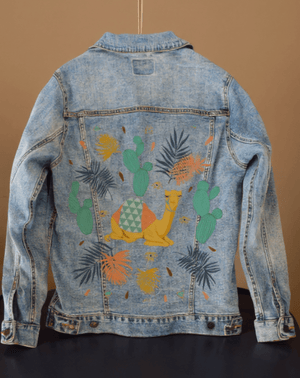
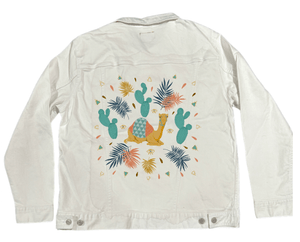
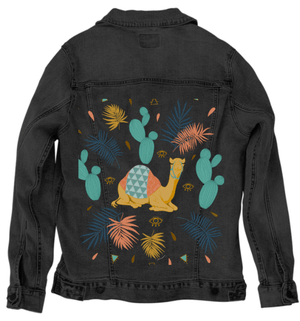
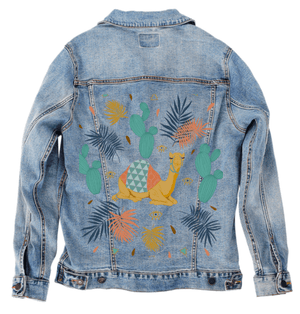
A stylized camel seated at center on a transparent background, facing slightly right, with a warm golden body and simplified facial features. The camel wears a patterned saddle blanket composed of teal geometric triangles bordered by coral and peach textures. Surrounding the camel are teal cacti, layered palm fronds in blue, teal, orange, and gold, and small symbolic motifs including yellow eyes, triangular shapes, and floating leaf-like marks arranged in a circular pattern. This artwork is titled “Camel” and created by Hend Shehata
The camel rests low at the center of the composition, legs folded beneath its body, posture calm and grounded. Its form is simplified but confident, outlined cleanly and filled with a warm golden hue that varies subtly across the body. The neck rises in a gentle curve, leading to a stylized face with closed or softly defined eyes and a faint, composed expression. Lines are smooth and intentional, with no fur texture — the surface feels matte and graphic, emphasizing shape over realism.
Across the camel’s back sits a patterned saddle blanket that immediately draws the eye. The central panel is filled with repeating teal triangles, each one crisp and evenly spaced, forming a geometric field. Around this, coral and peach sections introduce texture through small angular marks, creating contrast between flat geometry and patterned surface. The blanket follows the curve of the camel’s back, anchoring the animal visually and adding weight at the center of the piece.
Encircling the camel is a rhythmic arrangement of desert elements. Rounded teal cacti rise upright, their bodies marked with fine vertical lines that suggest ribs without sharpness. Palm fronds sweep inward from the edges, their long, narrow leaves layered in deep blue, teal, orange, and golden yellow. Each frond fans outward, individual leaflets clearly separated, creating movement that frames the stillness of the camel.
Smaller symbols float throughout the space. Stylized eyes in warm yellow appear between plants, evenly spaced, watching without direction. Tiny triangular shapes, some outlined, some filled, scatter around the perimeter, along with small leaf-like marks in peach and gold. These elements form a loose circular motion, guiding the eye around the composition while leaving the background open and breathable. The transparent negative space keeps everything suspended, with no ground line or horizon.
The balance between stillness and motion defines the piece. The camel remains steady and centered, while foliage and symbols orbit around it. Color relationships hold the harmony: teal and blue cooling the space, gold and coral warming it, all contained within clean shapes and deliberate spacing. The artwork feels contained, rhythmic, and quietly alert.
On stonewashed denim, the composition softens. The golden camel absorbs into the worn twill, its edges relaxing slightly as pigment diffuses. The geometric triangles of the saddle blanket blur just enough to feel aged, their sharpness mellowed by fabric texture.
The palm fronds on stonewashed denim become more atmospheric. Individual leaflets soften and blend, especially where blues meet greens. The floating symbols recede slightly, becoming impressions rather than crisp marks. Emotionally, the piece shifts toward warmth and familiarity, like a scene remembered.
Stonewashed denim gives the artwork a lived-in calm. The camel feels settled and enduring, the surrounding motion quieter, as if the entire scene has exhaled.
On white denim, clarity takes control. The camel’s silhouette becomes crisp, its golden tone clean and bright. The saddle blanket’s triangular pattern snaps into focus, each shape clearly defined. Coral and peach textures read as intentional decoration rather than surface noise.
The surrounding cacti and palm fronds separate cleanly on white denim. Blues and teals feel fresh, oranges and yellows pop, and the symbolic eyes and triangles become graphic accents. Emotionally, the artwork feels confident and declarative.
White denim frames the piece like a print. The balance between central stillness and surrounding motion becomes precise, giving the artwork a polished, gallery-like presence.
On black denim, the piece compresses into intimacy. The golden camel glows against the dark base, its body feeling warmer and more substantial. Teal triangles deepen, and the coral border of the saddle blanket becomes richer by contrast.
The palm fronds darken and intensify, their colors saturated and dramatic. The floating eyes and symbols glow softly, creating points of light within shadow. Emotionally, the artwork becomes cinematic and inward, drawing attention tightly around the camel.
Black denim transforms the scene into something protective and focused. The camel feels guarded, central, and powerful, surrounded by watchful forms.
On classic blue denim, balance emerges naturally. The teal cacti and palm fronds harmonize with the blue base, while the camel’s gold rises gently forward. Pigment settles into the twill evenly, preserving shape while adding texture.
The geometric saddle blanket remains readable but softened, its triangles interacting with the fabric’s weave. The surrounding symbols feel integrated rather than floating apart. Emotionally, the piece feels steady and grounded.
Classic blue denim gives the artwork a timeless, wearable presence. The camel feels at home, anchored yet calm, with movement and stillness held in quiet equilibrium.