A
Celtic Awen symbol inside a double-ring circle, featuring three vertical
knotwork lines beneath three circles, surrounded by an ornate circular border
with interlaced knot patterns and three tall pointed pillars filled with
intricate interlaced knotwork and three small round dots above. Four ornate
corner knot designs frame the circle, with small triquetra-style knots on the
left and right. The artwork uses smoky black-to-bronze gradients with a warm
golden light band crossing the center on a white background. This artwork is
titled “Celtic Awen” and created by Brigid Ashwood
You
drift first into the stillness of the circle — a double-lined ring that holds
the entire design the way a horizon holds the sun: firm, quiet, and absolute.
Inside it, three tall pillars rise like carved standing stones, each tapering
to a sharp point, each filled with interlaced knotwork that refuses to be
merely decorative. Above them hover three dark, perfectly round dots, evenly
spaced, like a measured breath taken three times and held. The white field
around everything isn’t empty; it’s silence — a deliberate negative space that
makes the symbol feel suspended, ceremonial, and unmistakably intentional.
Your
eye moves to the knots and stays there. The corner pieces are not generic
flourishes — each one is a dense, looping braid with leaf-like ends, lines
crossing over and under in a disciplined rhythm. In the upper corners, the knot
strands curl inward and re-emerge, forming layered loops that stack like
braided rope, then flare outward into pointed tips. In the lower corners, the
shapes echo the same interlace language but turn heavier and more grounded, the
loops tightening into compact turns before opening again at the edges. There’s
a micro-moment you can literally see where two bands overlap and the inner edge
turns slightly lighter — a thin highlight that clarifies which strand passes on
top. On denim, that highlight catches the twill’s raised ridges and breaks into
tiny glints, making the over-under illusion feel tactile rather than optical.
It matters because the knotwork becomes something you can feel as
structure — order made physical, intention made wearable.
A
shift in mood happens when you enter the three central pillars. Each pillar
contains its own interlaced path, with long vertical bands that fold inward,
loop, and return, creating a braided corridor that runs from the pointed tip
down to the wider base. Near the bottom of each pillar, the knot tightens into
a compact, looping flourish — a denser knot “cap” where curves stack and
overlap more frequently before resolving. This isn’t just one repeated pattern
pasted three times; you can see subtle variations in how the strands angle and
where the inner negative spaces widen. That specificity is what gives the
symbol authority — it reads like drawn craft, not icon shorthand.
Color
becomes emotion across the center of the piece, where a warm band of golden
light crosses through the dark gradients, like sunset caught in metal. The
upper and outer areas lean smoky black and deep brown; then the gold blooms
through the middle, softening into bronze and pale amber as it travels. The
gradients aren’t airbrushed flat — you can see soft transitions where pigment
density thickens near an edge, then fades, creating a stained-glass feeling
without hard outlines. On denim, those gradients don’t stay perfectly smooth;
they settle into the weave and become alive to motion, the light band shifting
subtly as the fabric bends. It matters because the piece doesn’t just sit there
— it reacts to life.
On
either side of the pillars sit smaller knot forms that read as triquetra-style
interlace — three-lobed, triangular knots with smooth, continuous bands. They
act like quiet attendants to the central structure, balancing the composition
laterally and reinforcing the language of three-ness without shouting it. The
double-ring circle contains them all, and you can see the ring’s line weight
remain consistent as it arcs — steady, controlled, framing the symbol like a
vow.
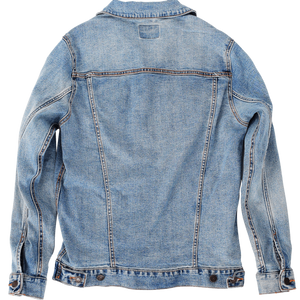
On
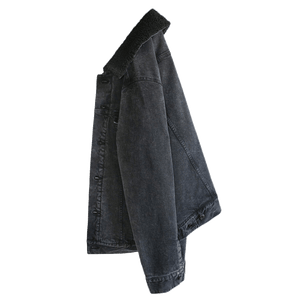
stonewashed denim, the whole piece turns atmospheric. The smoky blacks and
browns soften first, bleeding gently into the worn grain of the fabric so the
circle feels less like a printed boundary and more like a halo that has always
belonged there. The micro-highlights that separate the over-under strands in
the knotwork become slightly more textured — not lost, but transformed — as
pigment sinks into the twill valleys and the raised ridges catch light
unevenly. When the jacket moves, the knot crossings flicker subtly, like carved
grooves catching sun at different angles. The golden band across the center
warms and spreads, becoming less metallic and more like old light — the kind
that lives in memory.
Stonewash
also changes the negative space. The white field is no longer pristine; it
becomes fabric-bright rather than paper-bright, which makes the entire symbol
feel older, more talismanic. The pillars read like weathered standing stones,
and the corners feel like engraved corners of an illuminated manuscript. The
emotional pulse shifts toward heritage — protection, continuity, something
carried rather than displayed.
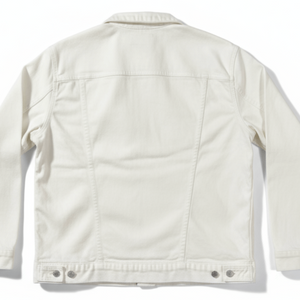
On
white denim, the design becomes crisp and architectural. The over-under logic
of the knotwork is easiest to read here: each strand edge is sharp, each
crossing clean, each inner pocket of negative space clearly shaped. The three
dots above the pillars become stark and perfectly measured, and the double-ring
circle feels like a precise instrument — not soft, not nostalgic, but exact.
The golden light band through the center reads brighter and more luminous, like
polished metal or sunlight on carved bronze. This clarity matters because it
makes the symbol feel declarative — a visible statement of order and intention.
White
denim also makes the corner knots feel more like engraving. You notice the way
the strands curve into leaf-like ends, the way loops stack, the way the line
weight stays disciplined through tight turns. As the jacket moves, the
crispness holds; the symbol stays legible at distance, and the knotwork
continues to reward up-close viewing, like a seal stamped into cloth.
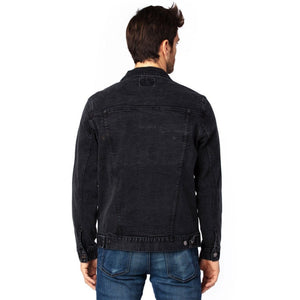
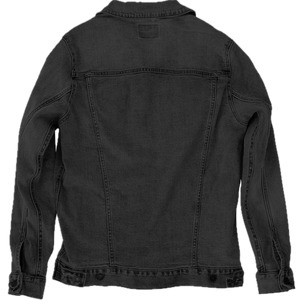
On
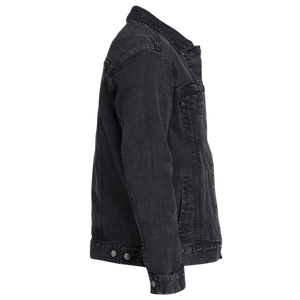
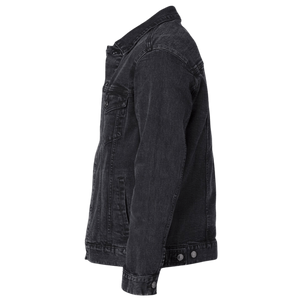
black denim, the piece becomes the most ceremonial. The smoky outer gradients
compress into the dark base, and the golden band across the center lifts
forward as the primary source of light — like firelight inside a circle. The
knot strands appear heavier and more carved, their edges defined by glow rather
than contrast, and the over-under crossings feel deeper, like channels cut into
stone. Those tiny inner highlights that signal “this strand passes over” become
precious here — small, controlled points of visibility that the eye has to
earn. It matters because the symbol feels secretive in the best way: not
hidden, but intimate.
Black
denim turns the circle into a portal. The three pillars become upright
presences, and the three dots above them feel like a quiet triad suspended in
night. As the jacket bends, the gold band shifts and pulses, and the knotwork
seems to move with the wearer — not changing shape, but changing light.
The emotional effect is protection and power held close: a disciplined calm, a
boundary, a center, something you wear like a vow.