Illustration of a vibrant,
multicolored dragon reclining with its wings folded, set in front of an
intricate Celtic knotwork mandala rendered in green, blue, and violet tones.
stylized dragon figures are woven into the knot design behind the main dragon,
forming a circular pattern with layered triskelion elements. Their bodies
formed entirely from continuous over-and-under knot strands in shades of green,
teal, and slate blue. this artwork is titled “Celtic Dragon” and created by
artist Brigid Ashwood
You
drift first into the weight of the foreground dragon’s body, resting low and
deliberate, its chest grounded and wings folded in a posture that feels ancient
rather than passive. The head turns slightly outward, horns curving upward with
controlled authority, while iridescent scales shift through greens, blues, and
violets like light moving across stone polished by time. This dragon does not
prepare to rise — it chooses stillness.
Behind
it, the Celtic circle holds the deeper rhythm of the piece. Intertwined within
the knotwork are three dragons, each one formed entirely from
continuous, unbroken strands of interlace. They are not outlined illustrations
placed inside the circle — they exist because the knot becomes them. One
dragon occupies the upper arc of the circle, its head angled inward, neck and
spine defined by looping bands that tighten near the shoulders before releasing
into broader curves. The second dragon coils through the lower-left section,
its body compacted into tighter turns, tail threading back into the ring. The
third completes the triad on the lower-right, its form shaped by wider arcs
that open and fold, creating a sense of outward reach before return. You can
trace each dragon by following a single strand as it passes over, then under,
then over again — no breaks, no shortcuts. On denim, those crossings sink into
the twill, making the dragons feel carved rather than drawn. It matters because
the knot doesn’t decorate the dragons — it binds them.
A
shift in mood happens at the center of the circle, where the three dragons’
paths converge into a triskelion-like junction. The knot compresses here,
curves tightening and pigment deepening as green transitions into darker teal
and slate. This is the point of greatest tension and balance — three forces
held in equilibrium. On fabric, this compressed center catches light first
along the raised ridges of the weave, so the convergence subtly pulses as the
garment moves. The knot feels alive without spinning, powerful without
aggression.
The
outer ring reinforces control. Its bands maintain consistent width as they arc
around the circle, weaving through corner-like flourishes that echo dragon
forms without repeating them. The over-under logic remains strict throughout,
and you can see micro-highlights where one strand rises above another — a thin
edge of light that signals hierarchy. On denim, these highlights fragment into
tactile glints, strengthening the illusion of depth. This discipline matters:
the dragons are not wild here — they are governed, ancient intelligence made
structural.
Then
your eye returns to the foreground dragon, and the contrast is immediate.
Unlike the intertwined trio, this dragon is fully dimensional, rendered with
layered scales, subtle highlights along muscle groups, and feathered
transitions at the wings and tail. Color flows rather than knots — emerald into
turquoise, indigo into violet, gold warming the horn ridges and facial planes.
The dragon exists in the present, while the three behind it exist in pattern
and memory. That separation is deliberate: the knot holds lineage; the
foreground holds embodiment.
Color
becomes emotion in how the two layers speak to each other. The knot dragons
remain cooler and more restrained, their greens and blues disciplined by
structure. The foreground dragon carries more spectrum, more life, more
immediacy. The pale halo around the circle lifts the knot away from the
background, allowing the dragon to sit in front without collapsing the space.
The entire composition breathes — depth without chaos.
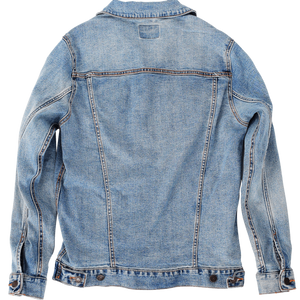
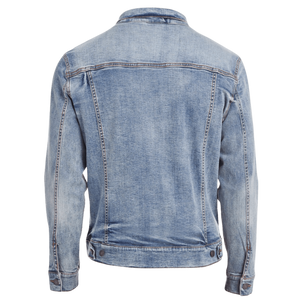
When
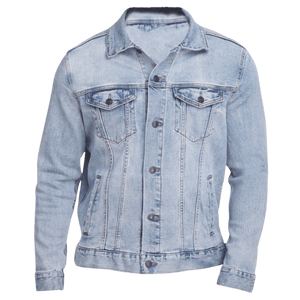
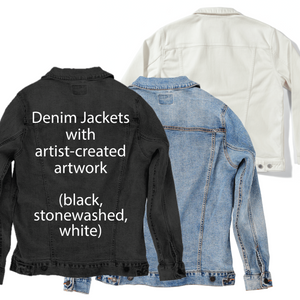
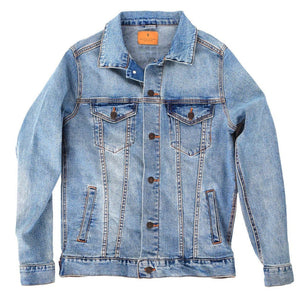
this artwork lives on stonewashed denim, the knot softens first. The over-under
crossings diffuse slightly as pigment settles into the worn grain, but the three
intertwined dragons remain clearly readable because their bodies are
defined by structure, not outline. The center convergence loosens into
atmosphere, making the rotation feel older, more mythic. As the jacket moves,
the knot’s crossings flicker gently, like memory surfacing through cloth.
On
stonewash, the foreground dragon’s scales mellow, their iridescence warming and
spreading. The horns lose a touch of sharpness, becoming more ceremonial than
threatening. The emotional tone shifts toward guardianship — power carried
quietly.
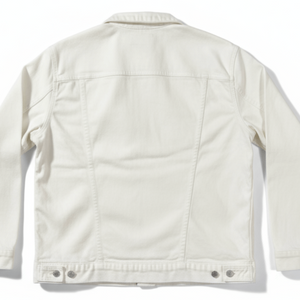
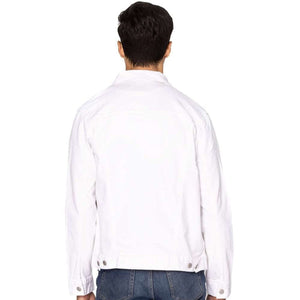
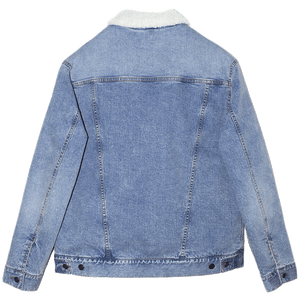
On
white denim, clarity asserts itself. Each of the three knot dragons
becomes easy to count and trace, their individual placements unmistakable. The
over-under logic reads clean and architectural, and the central convergence
feels precise and intentional. The foreground dragon brightens, its color
gradients crisp, its posture commanding. This clarity matters because it frames
the image as declaration — strength made visible.
The
knot on white denim reads like engraved metal or illuminated manuscript work,
disciplined and exact, while the dragon in front feels vividly alive.
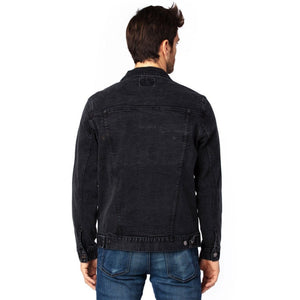
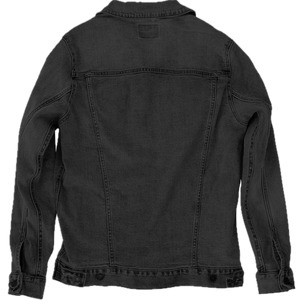
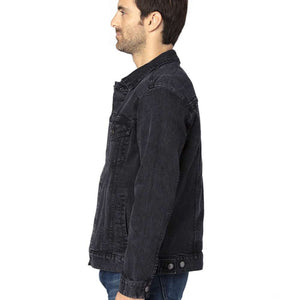
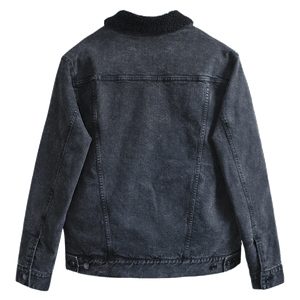
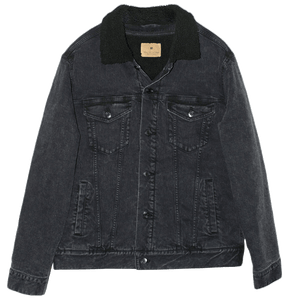
On
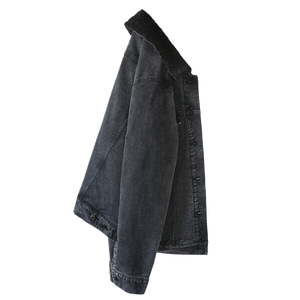
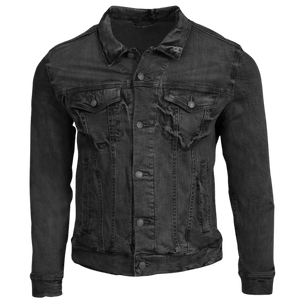
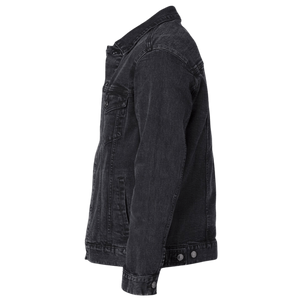
black denim, the piece becomes sovereign. The knot glows in layered greens and
teals against the dark base, and the three intertwined dragons feel
deeper, heavier, almost carved into shadow. The central convergence reads like
contained fire. The foreground dragon partially merges with the base, its
highlights and eyes becoming the primary points of emergence.
As
the fabric folds, the knot’s crossings appear and disappear, and the three
dragons seem to rotate slowly within the circle. The foreground dragon remains
grounded and watchful. On black denim, the artwork feels like a sigil of power
and lineage — three dragons bound into one system, with one embodied
guardian before them — worn not for decoration, but for meaning.