Illustration of two detailed
dragonflies with iridescent blue and purple wings, ne flying at upper right and
one angled at lower left, set before an intricate Celtic knotwork mandala in
cool blue tones in deep navy on a smoky blue-lavender halo, with three stylized
dragonfly figures are intertwined within the knotwork, their bodies formed from
continuous over-and-under strands. this artwork is titled “Celtic Dragonfly”
and created by Brigid Ashwood
You
drift first into the glassy shimmer of wings—two dragonflies suspended in front
of a dark Celtic circle as if the air itself has thickened into light. The
upper dragonfly holds the space with wings stretched wide, the membranes
catching icy blues and violet sheen, each vein line mapping the wing like a
delicate lattice. Below, the second dragonfly tilts diagonally, body longer and
closer to the surface of the scene, wings angled as if it has just skimmed past
a wave of glittering mist. The atmosphere feels cold and luminous, like
twilight over water, where every movement leaves a faint trail behind it.
Your
eye gets pulled backward into the knot, and this is where the structure
tightens. Intertwined within the Celtic knotwork are three dragonflies,
and they are not “decorations placed on top”—they exist because the interlace
becomes their bodies. One dragonfly is positioned at the top center,
formed from the knot’s vertical axis: you can see a slender body shape with
symmetrical wing forms suggested by looping strands, and a curled, spiral-like
tail element that turns downward into the braid. A second dragonfly is embedded
toward the lower left interior, its body defined by a tighter cluster of
crossings where the knot compresses, with wing shapes implied by paired loops
that mirror one another. The third is embedded toward the lower right
interior, completing the triad so the motif repeats three times around the
circle. The micro-truth is in the crossings: at each dragonfly form, a strand
edge lightens slightly where it passes “over,” then darkens where it dips
“under,” clarifying the weave’s hierarchy. On denim, those over-under
transitions settle into the twill valleys and ridges, so the dragonflies feel
less drawn and more engraved—like the knot has been pressed into cloth. It
matters because the symbol reads as order containing motion: three dragonflies
bound into a system, while two live freely in front.
A
shift in mood happens when you compare the knot-dragonflies to the foreground
pair. The knotwork is disciplined—deep navy bands with consistent thickness,
looping in and out with almost architectural calm. The foreground dragonflies,
by contrast, are all shimmer and breath: wing membranes fade from pale cyan
into lavender and deeper violet at the edges, and the bodies glow in segmented
blues with hints of teal and magenta near the abdomen. The wings carry crisp
vein geometry, and you can see the slight thickening where the leading edges
meet the body—tiny structural “bones” that hold the translucence in place. On
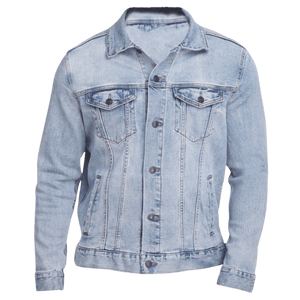
denim, that translucence transforms: pale membranes become softly textured,
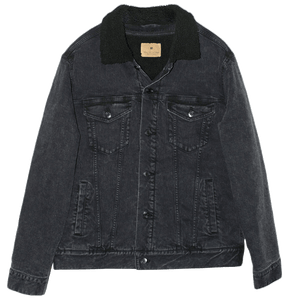
veins sharpen on white, and on black the wings look like stained glass lit from
behind. The emotional pulse changes with that—clarity feels like alertness,
softness feels like memory, contrast feels like power.
Below
the dragonflies, starry splashes and mist flare outward in pale blues and
silvery-white specks, like water spray turned into constellation dust. The
particles aren’t uniform; some dots cluster densely, others drift outward in
faint haze. On fabric, these specks embed into the weave unevenly, so the
“spray” feels alive when the jacket moves—light catching different points with
every fold. It matters because the piece doesn’t sit still. It performs.
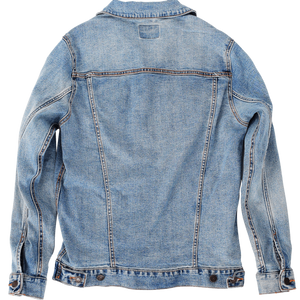
On
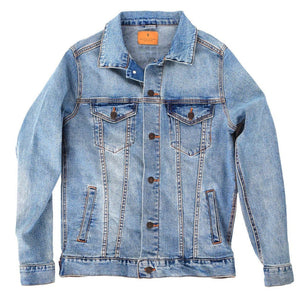
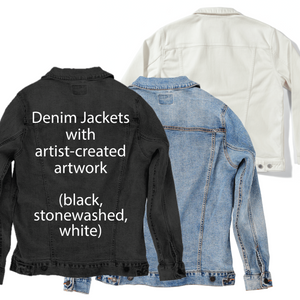
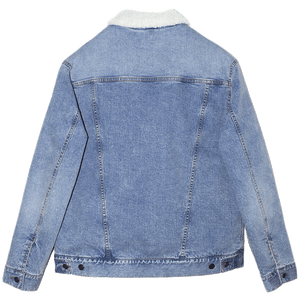
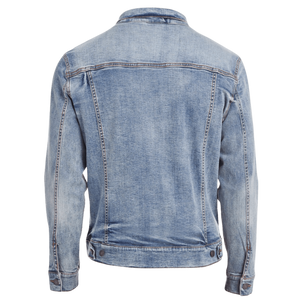
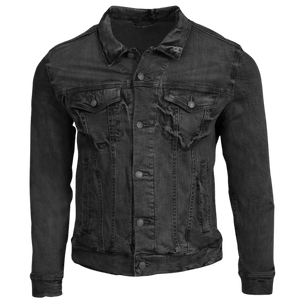
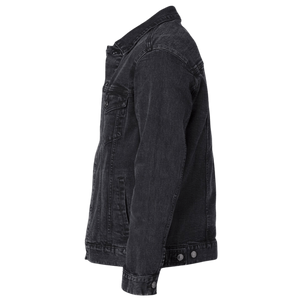
stonewashed denim, the entire scene turns atmospheric first. The smoky
blue-lavender halo behind the knot blooms outward as pigment settles into worn
grain, making the circle feel like fog around midnight architecture. The three intertwined
dragonflies inside the knot remain readable, but their crossings soften
slightly, so the motif feels older—less graphic, more talismanic. The
foreground wings lose a touch of razor-sharpness and become velvety, as if the
air has thickened; the mist and star-spray embed into the fabric like frost. As
the jacket moves, the softened speckles flicker gently, and the dragonflies
feel like they’re gliding through memory instead of air.
On
stonewash, the dark knot bands pick up subtle texture from the twill ridges,
which makes the over-under logic feel carved. The emotional tone shifts toward
quiet enchantment—movement slowed, shimmer mellowed, stillness made sacred.
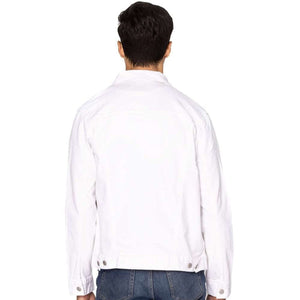
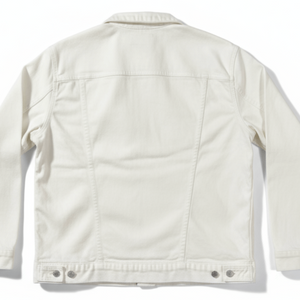
On
white denim, everything snaps into precision. The knotwork becomes
sharply legible—every over-under crossing clear, every loop clean, and the
three intertwined dragonflies easiest to count and trace because the
negative spaces around their bodies read crisply. The foreground dragonflies
brighten dramatically: wing veins look more like fine wirework, and the
cyan-to-violet gradients feel luminous and airy. The starry spray reads like
suspended light rather than mist, and the whole piece feels awake—winter
sunlight on water.
On
white, the contrast between “symbolic dragonflies inside the knot” and “living
dragonflies in front” becomes almost musical: structure behind, motion in
front, both held in perfect balance.
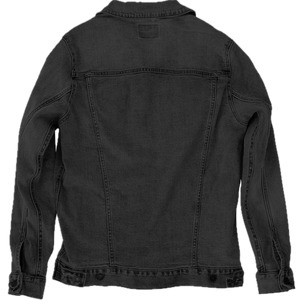
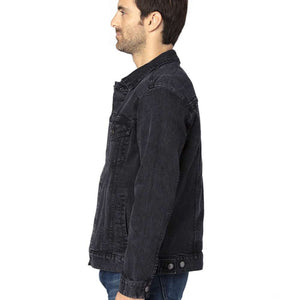
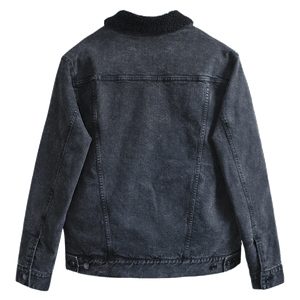
On
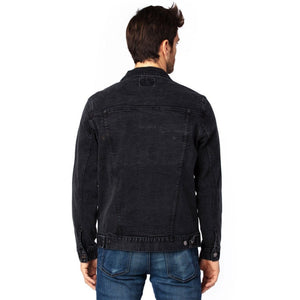
black denim, the artwork becomes cinematic. The knot circle glows like
deep navy ink against night, and the three intertwined dragonflies feel
engraved into shadow—crossings deepening, loops reading like carved channels.
The foreground dragonflies become the primary light source: wings look like
stained glass, with bright cyan centers and violet edges igniting against the
dark base. The mist and speckles appear and disappear as the fabric folds, like
constellations surfacing, then sinking back into night.
On
black, the piece feels protective and powerful—two dragonflies alive in the
present, three held in symbol behind them—motion and meaning worn close,
shimmering only when you move.