Illustration
of two realistic barn owls set before a glowing golden-brown Celtic knot
mandala. one owl stands upright with folded wings and soft ivory, gray, and
tawny plumage, while a second owl flies low with wings fully spread. within the
circular knotwork, two stylized owls are visibly woven into the design, their
heads and wings formed from continuous over-and-under bands and spiral motifs.
gold dust, swirling brush textures, and light sweep across the foreground. this
artwork is titled “Celtic Owl”and created by Brigid Ashwood
You
drift first into the hush of wings. One owl stands tall and still, feathers
layered in soft gray, cream, and warm brown, its face turned slightly downward
as if listening rather than looking. Beside it, another owl cuts low through
the air, wings spread wide and angled forward, each feather separated just
enough to catch light. Gold dust arcs beneath them, not explosive but
ceremonial, like a slow blessing cast across the ground. The moment feels
suspended between motion and watchfulness.
Your
eye is drawn backward into the Celtic knot, and this time the figures are
unmistakable. Two owls are visibly intertwined within the knotwork, not
implied, not symbolic—clearly drawn and intentionally placed. One owl occupies
the upper center of the knot, wings fully spread and symmetrical, its
head centered and facing forward. The wing shapes are formed directly from the
knot’s curved bands, with the feathers suggested by layered arcs that expand
outward before looping back into the braid. The second owl appears in the lower
left section of the knot, rotated in orientation, its head angled and wings
folded closer to the body, the form defined by tighter spiral turns and shorter
interlaced paths. You can literally see where the knot strands pass over and
under to create the owls’ bodies—edges lighten where a band rises, darken where
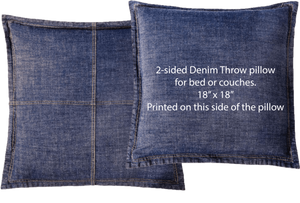
it dips. On denim, those crossings settle into the twill’s ridges and valleys,
giving the owls an engraved quality, as if the birds were pressed into the
cloth itself. It matters because these owls are not decorative—they are
structurally bound into the knot.
A
shift in mood happens when you compare the two knot-owls to the two painted
owls in front. The intertwined owls behind are disciplined and eternal,
held by geometry and rule. The foreground owls are alive with texture. The
standing owl’s feathers stack in soft, overlapping layers, darker along the
wings and shoulders, lighter along the face and chest. The flying owl shows
motion through its wing spread—long feathers fanning outward, shorter feathers
layering closer to the body. On denim, the feather highlights fracture slightly
across the weave, making the plumage feel tactile rather than smooth. The
emotional pulse lives there: vigilance made physical.
Color
becomes emotion in the gold and bronze tones of the knot. The interlace reads
like carved metal—warm, ancient, controlled—while the pale halo around it lifts
the symbol away from the background just enough to breathe. Small triquetra
accents appear around the perimeter, punctuating the larger structure without
interrupting it. The knot does not compete with the owls; it holds them in
balance.
The
foreground gold dust and light sweep acts as a threshold between worlds. Its
particles vary in size—some sharp points, others soft haze—and on fabric they
embed unevenly, so the arc appears to shimmer as the jacket moves. This matters
because the artwork doesn’t sit still; it responds to motion, like the owls
themselves.
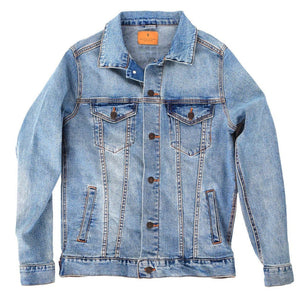
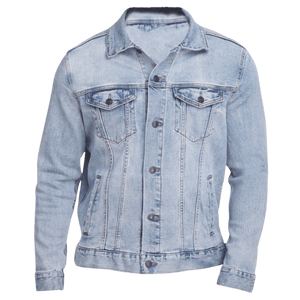
On
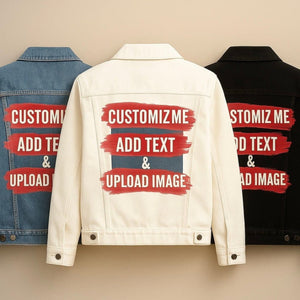
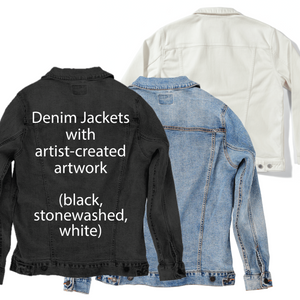
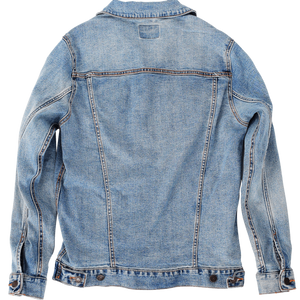
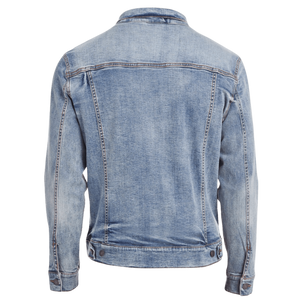
stonewashed denim, the knot softens first. The over-and-under crossings
blur slightly as pigment spreads into the worn grain, but the two
intertwined owls remain clearly readable because their silhouettes are bold
and intentional. The gold tones mellow into something older and more
talismanic. The foreground owls soften as well, their feather edges rounding
into a lived-in realism. As the jacket moves, light breaks unevenly across the
knot and wings, giving the impression of breath and quiet presence.
Stonewash
shifts the emotional tone toward guardianship—wisdom carried gently, not
announced.
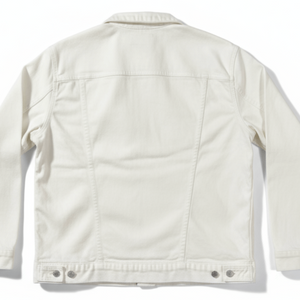
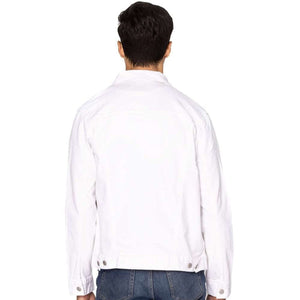
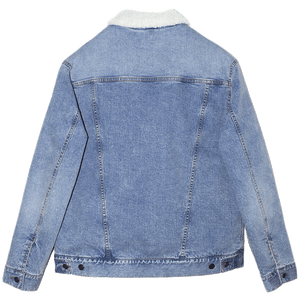
On
white denim, clarity asserts itself. The two intertwined owls in
the knot are easiest to count and trace here: wing spans read cleanly, head
shapes are crisp, and the over-under logic of the interlace is unmistakable.
The gold knot brightens and feels engraved rather than weathered. The
foreground owls become sharply defined—the standing owl’s facial disc luminous,
the flying owl’s wing structure precise. This clarity matters because it frames
the image as conscious vigilance.
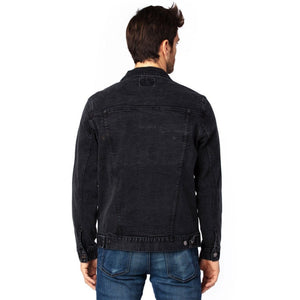
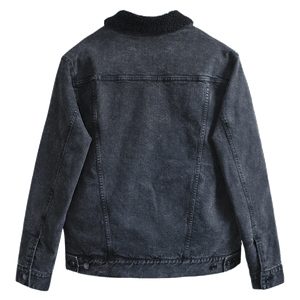
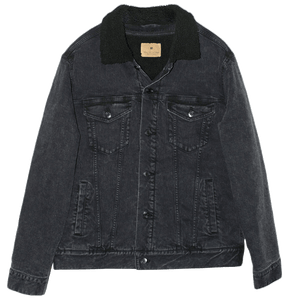
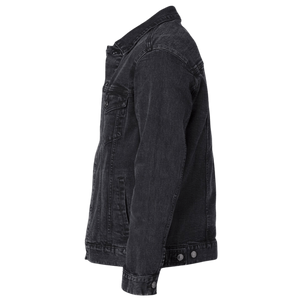
On
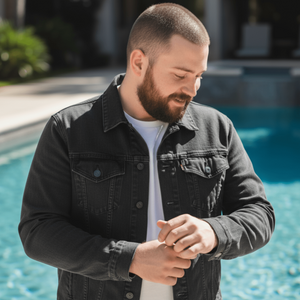
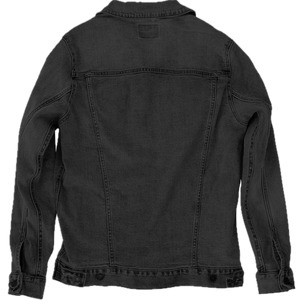
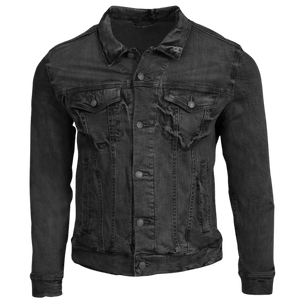
black denim, the piece becomes intimate and ceremonial. The knot glows
in bronze against the dark base, and the two intertwined owls feel
carved into shadow, their wing shapes emerging from darkness as light catches
raised crossings. The standing owl partially merges with the base, but its
highlights and gaze lift forward with authority. The flying owl’s wings glow
along the edges, cutting through the dark like a silent passage.
On
black denim, the artwork feels like a vow of watchfulness—two owls bound
into eternal knotwork behind two living owls in the present—wisdom, motion,
and stillness held together, worn close, revealed only when you move.