Illustration of a pale silver-white
unicorn reclining before a glowing blue Celtic knotwork mandala set on a soft
lavender halo. the unicorn has a long spiraled horn, a pastel lavender-and-aqua
mane and tail, and a delicate rose garland around its neck. within the circular
knot, three stylized unicorns are visibly woven from continuous over-and-under
strands arranged around a central triquetra. subtle star-like sparkles glint
across the knot and horn. this artwork is titled “Celtic Unicorn” by Brigid
Ashwood
You
drift first into the unicorn’s quiet weight against the ground—body folded in
repose, legs tucked beneath, the curve of the back smooth and unhurried. Its
coat is a pale silver-white that doesn’t read as flat; it’s shaded with soft
lilac-gray shadows that gather under the belly and along the flank, giving the
animal depth like moonlight resting on stone. The horn rises long and straight,
spiraled with faint ridges that catch the light, and the mane falls in braided,
ribbon-like strands that shift through cool aqua, lavender, and pearl. A small
garland of roses rests at the throat, clustered petals in pink and mauve tucked
against the chest like an offering rather than adornment.
Your
eye is pulled backward into the Celtic circle, and here the structure becomes
unmistakably narrative. Intertwined within the knotwork are three unicorns,
each one visibly unicorn by form—head, neck, legs, and a distinct horn—built
directly from continuous interlaced strands. One unicorn occupies the upper
section of the circle, shown in profile as if standing, its horn angled
forward and catching a star-like glint near the head. The body is formed by
looping bands that cross and return through its torso, so the unicorn exists
because the knot becomes anatomy. A second unicorn is embedded in the lower-left
section, rotated in orientation, its head and horn clearly visible while
the body compresses into tighter turns where the interlace knots more densely.
The third completes the triad in the lower-right section, again in
profile, its horn and forelegs defined by the negative spaces created when
thick lines pass over and under. You can trace each unicorn’s body by following
a single strand as it rises “over,” dips “under,” then emerges again—no breaks,
no shortcuts. On denim, those crossings settle into the twill valleys and catch
on the ridges, giving the three knot-unicorns a carved depth, as if the symbol
is embossed into fabric. It matters because the unicorns aren’t merely
pictured; they are bound into continuity.
A
shift in mood happens at the center where the knot compresses into a
triquetra-like convergence. The lines tighten, spirals gather, and the pale
inner bands glow warmer—ivory and soft blush—against the cooler blue ring
outside. Small star glints punctuate the design: one near the upper unicorn,
another near the center, and one toward the right side of the knot, like tiny
points of light caught on metal. On fabric, these glints become the first
places the eye lands because they catch light differently across folds, making
the whole symbol feel reactive to movement. The knot doesn’t move, but it shimmers.
Then
your attention returns to the foreground unicorn, and the contrast is the heart
of the piece. The three unicorns inside the knot are disciplined and
symbolic—constructed out of rule and repetition. The unicorn in front is
intimate and physical: its hooves darken softly at the base, the muzzle is
shaded with cool gray, and the mane’s braided strands separate into individual
ribbons that curl at the ends into pastel loops. On denim, those pale gradients
behave dramatically depending on base: the coat’s soft shadowing becomes
velvety on black, luminous on white, and gently diffused on stonewash. The
emotional pulse lives in that transformation—myth turning into something you
can wear, touch, and carry.
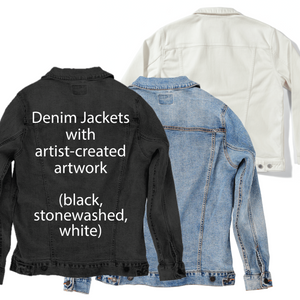
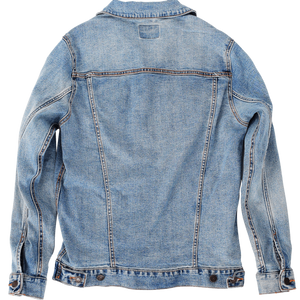
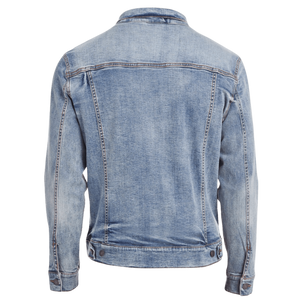
On
stonewashed denim, the lavender halo behind the knot blooms outward,
softening the hard edge of the blue interlace. The over-under crossings remain
readable, and the three intertwined unicorns stay countable, but their
lines gain atmosphere as pigment spreads into the worn grain. The foreground
unicorn’s coat becomes softer and more organic, its shadows warming slightly,
while the pastel mane blends into gentle gradients that feel like brushed silk.
The rose garland embeds into the fabric and becomes more nostalgic—like pressed
flowers kept in a book. As the jacket moves, the star glints flicker subtly,
making the symbol feel like a memory of light rather than a fixed shine.
On
stonewash, the overall mood becomes ancient and tender—protection without
hardness.
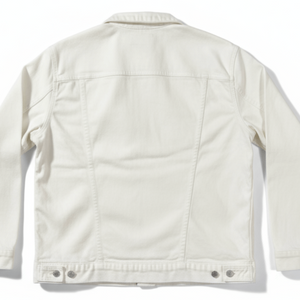
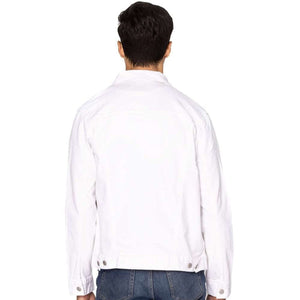
On
white denim, clarity asserts itself. The three intertwined unicorns
inside the knot are easiest to trace here: horns crisp, legs clearly separated,
and the over-under logic legible at every crossing. The blue ring becomes
graphic and precise, and the pale inner lines glow cleanly. The foreground
unicorn brightens into a luminous presence; the coat reads like pearl, and the
pastel mane becomes vivid, each braided strand distinct. The rose garland pops
with crisp edges and saturated petals. This clarity matters because it turns
the artwork into declaration—magic made visible, structure made unmistakable.
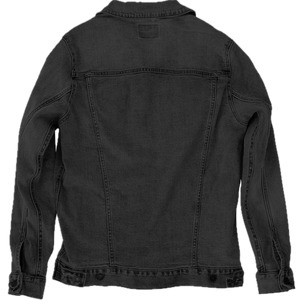
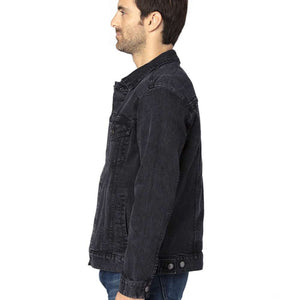
On
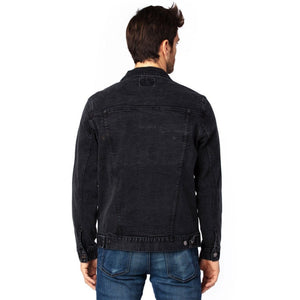
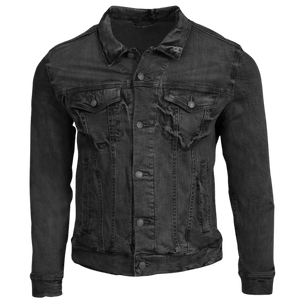
black denim, the piece turns cinematic and intimate. The blue knot ring
glows against the dark base, and the three intertwined unicorns feel
carved into shadow, their horns and bodies emerging through luminous edges. The
lavender halo becomes deeper and moodier. The foreground unicorn’s pale coat
becomes the primary light source, glowing softly against black, while the
pastel mane and tail take on jewel-like intensity. The star glints read as tiny
sparks in night, appearing and disappearing as fabric folds.
On
black denim, the artwork feels like a sigil of quiet sovereignty: three
unicorns bound into eternal knotwork behind one living unicorn in the present,
magic held close, revealed fully only when you move.