Illustration ofan
intricate blue Celtic knotwork mandala in icy blue and deep navy tones,
composed of interlocking spirals and woven lines. three stylized wolves are
visibly integrated into the circular design, each formed from continuous
over-and-under bands with spiral motifs inside their bodies, rotating around a
central triskelion-like negative space. small triquetra symbols appear at the
left, right, and bottom edges. This artwork is titled “Celtic Wolf” and created
by artist Brigid Ashwood
You
drift first into the rotation—three wolves locked into a circular chase that
never breaks, their bodies built from one continuous language of line. The
palette is cold and luminous: pale icy blues fill the inner paths while darker
navy outlines hold the edges like carved borders. At the center, a three-armed
negative space opens like a quiet triskelion, not drawn as a symbol so much as
revealed by the way the wolves’ bodies curve away from it. The whole design
feels like wind patterned into permanence.
Your
eye finds the first wolf at the upper left, head angled inward with a
clearly defined snout and ear, the jawline suggested by a sharp inward curve of
the band. Inside its torso, spiral motifs tighten and release, like muscles
coiling beneath skin. The second wolf occupies the right side, its head
turned inward as well, body arcing downward and back up, with a long limb shape
and paw-like end implied by the taper of the interlace. The third wolf sits at
the lower left, completing the triad, its body stretched along the curve
with the head and foreleg shapes readable through negative space. These are not
three identical stamps—each wolf’s posture shifts slightly with the circle’s
flow, so the rotation feels alive rather than mechanical.
The
micro-truth is in the over-under discipline. At several crossings—especially
where a wolf’s back loops past a neighboring band—the edge lightens to show a
strand rising “over,” then deepens where it slips “under.” Those tiny hierarchy
cues make the wolves feel woven, not outlined. On denim, that hierarchy becomes
tactile: pigment settles into the twill valleys at the “under” passages, while
the “over” edges catch light on raised ridges. The wolves begin to feel
embossed into cloth, like an engraved seal you can wear.
A
shift in mood happens at the spiral fields inside each wolf. The spirals are
not random decoration; they echo the curve of ribcage and haunch, tightening
near the shoulders, widening along the belly, then tightening again near the
hips. The effect is kinetic—motion mapped into the body. Around the perimeter,
the circle’s border thickens and thins slightly, reinforcing the sense of a
current running clockwise through the design. Small triquetra symbols sit
outside the main ring at left, right, and bottom, acting like quiet anchors
without stealing focus.
Color
becomes emotion through restraint. The icy blues feel like breath in winter
air; the deep navy feels like shadowed stone. There is no background scene, no
landscape—only the wolves and the logic that binds them. The atmosphere is not
wilderness; it is ritual, the idea of pack-motion turned into geometry.
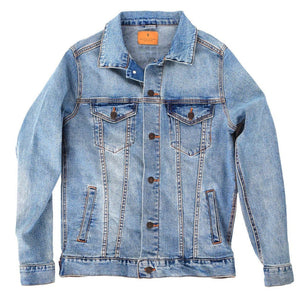
On
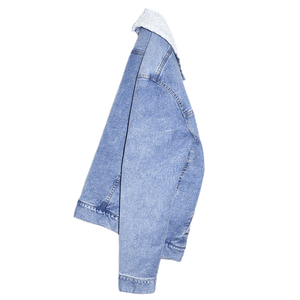
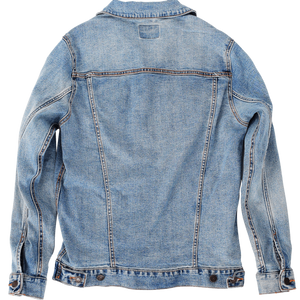
stonewashed denim, the icy blues soften into the weave, and the navy
outlines spread slightly into the grain, making the wolves feel older and more
talismanic. The over-under crossings remain readable but gain texture, as if
carved lines have been worn smooth over time. As the jacket moves, the spirals
flicker with subtle tonal shifts, and the rotation feels slower, more like
memory than chase.
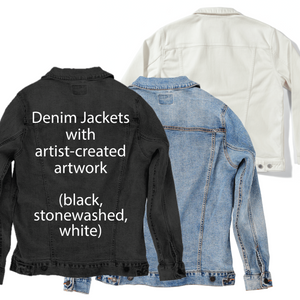
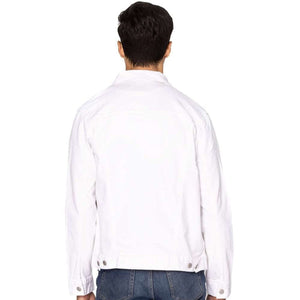
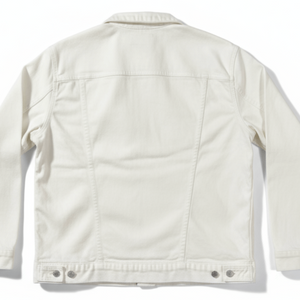
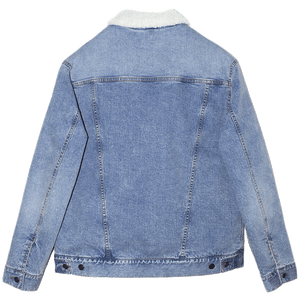
On
white denim, the design becomes crisp and architectural. Every wolf is
easiest to count and trace here, and the spiral interiors read like engraved
plates. The negative-space triskelion at center becomes stark and precise. This
clarity matters because it turns the symbol into declaration—three wolves, one
continuous system, unmistakably visible.
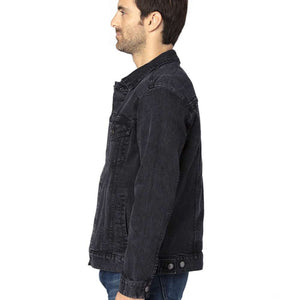
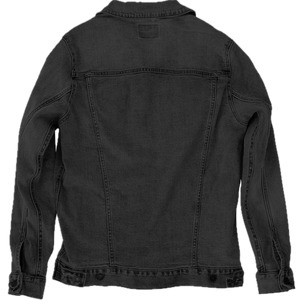
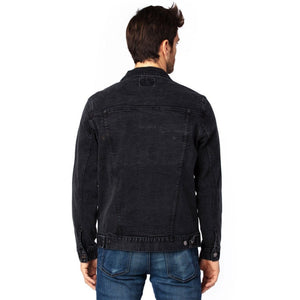
On
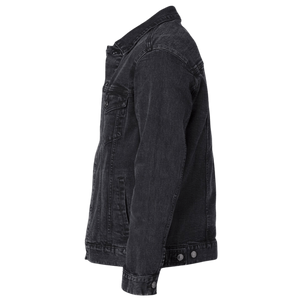
black denim, the piece becomes powerful and inward. The navy outlines
partially merge with the base, while the icy blues lift forward as luminous
pathways. The wolves feel carved out of night, their bodies defined by glow and
absence. The triquetra accents at the edges appear and disappear as the fabric
folds, like a seal revealed only in motion.
On
black, the artwork reads as a protective sigil: three wolves bound into one
endless rotation, carried close, activated by movement, disciplined as
knotwork and alive as breath.