Illustration
ofan elaborate Celtic knotwork triple-moon symbol rendered in luminous
blue, indigo, and violet tones. two mirrored crescent moons formed entirely
from continuous interlaced knot bands face inward toward a central circular
knot framing a pale full moon disk. the flowing loops create a balanced
horizontal composition set against a deep, star-filled night sky dotted with
soft white and blue points of light. this artwork is titled “Crescent Moon” and
created by artist Brigid Ashwood
You
drift first into the night itself — a deep, velvety field of indigo scattered
with countless small stars, some sharp, some softly blurred, like distant
breath against darkness. The sky is not empty; it feels alive, gently vibrating
with depth. Suspended across this expanse stretches the knotwork, glowing cool
and luminous, as if drawn from moonlight rather than ink.
Your
eye finds the two crescent moons, and this is where the truth of the
piece becomes clear: they are not symbols laid atop the design — they are
made of the knot. Each crescent curves inward from opposite sides,
perfectly mirrored, their horns tapering elegantly at the ends. The knot bands
thicken slightly along the outer arcs of each crescent, then narrow as they
turn inward, creating the unmistakable silhouette of waxing and waning forms
facing one another. You can trace a single strand along each crescent and see
it pass over, then under, then over again without interruption. On denim, these
over-under transitions would settle into the twill, making the crescents feel
embossed — moon shapes you can almost feel with your fingers. It matters
because the moons are constructed, not implied.
Between
them sits a central circular knot, smaller but denser, acting as the
quiet fulcrum of the composition. At its heart glows a pale, round disk —
unmistakably moon-like — held in place by tightly looping bands that spiral
inward before releasing outward again. The knot here compresses, its crossings
closer together, giving the center more weight. The crescents do not touch this
circle, but they lean toward it, creating a visual tension that feels like
orbit rather than contact.
A
shift in mood happens when you notice how the knot logic changes along the
moons. Along the outer edges, the lines are smoother and more elongated,
emphasizing flow and curve. Along the inner edges, where the crescents face the
center, the interlace tightens, spirals appearing more frequently, as if
gravity increases closer to the moon’s core. The micro-detail lives in the
highlights: thin, cool glints along the topmost strands show which paths rise
forward, while deeper blues mark where bands dip behind. On fabric, those
highlights would catch first as the jacket moves, giving the illusion that the
moons subtly brighten and dim with motion — like phases.
Color
becomes emotion through restraint. The palette stays firmly within cool blues,
teals, and violets, with no intrusion of warmth. This choice reinforces the
nocturnal calm — not dramatic night, but contemplative night. The stars behind
vary in size and density, some clustering more heavily toward the center,
others fading toward the edges, enhancing the sense that the knotwork floats in
open space rather than sitting against a flat backdrop.
There
are no animals, no figures, no narrative intrusions here. The entire
image resolves into celestial geometry — time, cycle, balance. The symmetry of
the two crescents is not rigid; it breathes slightly through subtle variations
in line thickness and spiral placement, preventing the design from feeling mechanical.
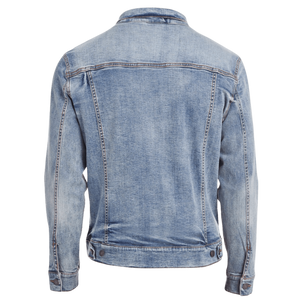
On
stonewashed denim, the moons soften into atmosphere. The cool blues
diffuse gently into the worn grain, and the star field embeds unevenly, making
the sky feel textured and deep. The over-under crossings of the crescents
remain readable, but their edges mellow, turning the moons into something
ancient — like lunar carvings weathered by centuries. As the fabric moves, the
crescents seem to glow and recede in slow rhythm, echoing real lunar cycles.
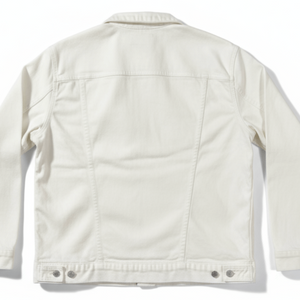
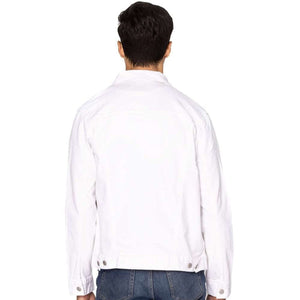
On
white denim, clarity takes hold. The knot logic becomes crisp and
architectural, and the two crescent moons are immediately legible at
distance. The central moon disk brightens, and the star field reads as precise
points of light. This clarity matters because it frames the artwork as
intentional structure — celestial order made visible.
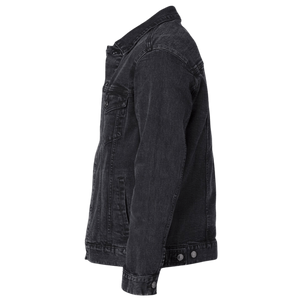
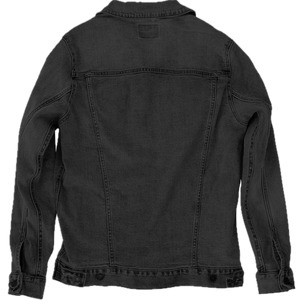
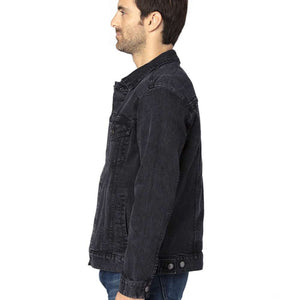
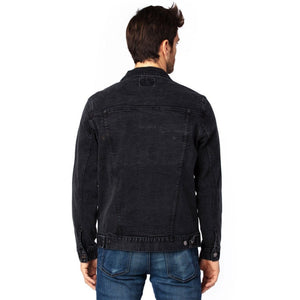
On black denim, the piece becomes intimate and
powerful. The blues and violets ignite against the dark base, and the crescents
feel carved out of night itself. Highlights along the knot bands glow sharply,
while the inner spirals deepen into shadow. The stars appear and disappear as
the fabric folds, giving the sense that the sky itself is moving