A
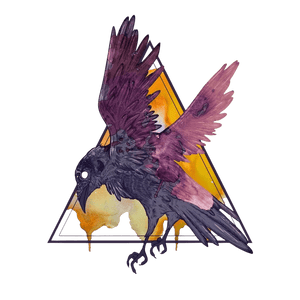
crow mid-flight with wings fully spread, angled diagonally downward, its body
rendered in dark charcoal and blue-black tones with layered feather linework. The
wings shift into deep plum and mauve washes, with watercolor drips trailing
from the feathers. Behind the bird sits a thin-outlined triangle filled with
warm yellow and orange washes that pool and drip downward. the crow’s talons
extend forward, claws open, and its eye appears as a small dark circle. this
artwork is titled “Crow Watercolour” and created by Jess Adams
You
drift first into motion held in place. The crow is captured mid-flight, body
angled downward from left to right, wings stretched wide and asymmetrical. The
left wing rises higher, its feathers layered thickly and fanning outward, while
the right wing extends back with a softer edge. The bird’s head dips forward,
beak pointed down, eye rendered as a small, dark circle that anchors the face.
Linework builds density through the torso, each feather overlapping the next,
creating a sense of weight even as the bird moves through air.
Color
begins to change across the wings. Dark charcoal and blue-black tones dominate
the body, then dissolve into deep plum, mauve, and wine-colored washes toward
the outer feathers. The watercolor bleeds unevenly, leaving darker pools near
feather bases and lighter, translucent edges at the tips. Thin drips fall from
the wings, pulling pigment downward and giving gravity a visible role in the
image. The crow’s talons extend forward, claws open and curved, their thin
outlines sharp against the softer color fields.
Behind
the bird, a triangular frame holds the composition steady. Its edges are clean
and geometric, outlined in dark lines, while the interior glows with warm
yellows and oranges. The wash inside the triangle pools toward the bottom,
forming rounded drips that echo the feather drips above. The crow overlaps the
triangle, breaking its symmetry and flattening the space so that bird, shape,
and wash exist on the same visual plane. The background remains empty, allowing
motion and color to command full attention.
A
new kind of tension settles in. The crow is not soaring upward or landing — it
is suspended between actions. Feather edges remain sharp in places, then
dissolve into softness where watercolor overtakes line. The triangle does not
recede into background symbolism; it simply holds heat and light behind the
bird’s darker mass. The emotional pulse comes from restraint: energy contained,
motion paused just before impact.
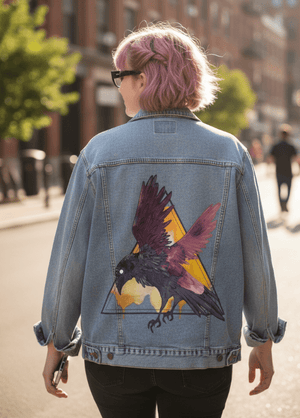
On
stonewashed denim, the watercolor qualities deepen. Plum and mauve pigments
sink into the softened twill, spreading outward and blurring feather edges.
Drips elongate slightly as the fabric’s texture pulls color downward, making
the wings feel looser and more atmospheric. Emotionally, the crow feels older
here, less urgent, as if its motion has slowed into memory.
The
dark body feathers on stonewash lose some of their sharp separation, blending
into a unified mass. Linework remains visible but subdued, and the talons feel
less sharp, more integrated into the garment. The overall feeling shifts toward
quiet endurance — motion remembered rather than occurring.
On
white denim, the artwork snaps into clarity. Every feather edge becomes
readable, especially where dark ink meets lighter washes. The contrast between
the charcoal body and plum wings is pronounced, and the watercolor drips appear
intentional and graphic rather than fluid. The crow feels alert, decisive, and
fully present.
The
yellow-orange triangle on white denim becomes luminous. Its internal pooling
and drips stand out crisply, reinforcing the geometry behind the bird.
Emotionally, this version feels declarative and bold, emphasizing control over
chaos and motion over softness.
On
black denim, the piece turns cinematic. The crow’s dark body blends closely
with the fabric, allowing highlights along feather ridges and wing edges to
emerge selectively. Plum and mauve tones glow softly, appearing richer and more
saturated against the black base. The bird feels closer and more guarded, its
movement quieter and more internal.
The
triangle recedes slightly on black denim, becoming a warm halo rather than a
structural frame. Drips appear heavier, slower, and more intimate. Emotionally,
the artwork shifts toward intensity held close — motion compressed into depth,
as if the crow is moving through shadow rather than open air.