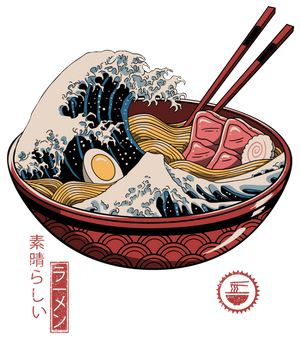
A stylized ramen bowl combining food and ocean imagery, with golden noodles forming waves and a large cresting blue-and-white wave rising from the left side of the bowl. Inside the bowl are sliced pink meat, a halved soft-boiled egg with yellow yolk, and a spiral fish cake. red chopsticks rest at the rim. The bowl is red with repeating geometric patterns, Japanese characters printed at lower left, and a circular ramen seal at lower right, all set against a black background. This artwork is titled “Great Ramen Wave” and created by Vincent Trinidad
The wave dominates the bowl before the food reveals itself. A powerful crest rises from the left side, rendered in layered blues, off-white foam, and deep navy shadows. The wave curls inward, its edge broken into claw-like sprays and droplets, each one carefully separated so the motion feels frozen at its peak. The foam is thick and sculpted, curling back on itself, while darker water beneath suggests weight and depth rather than surface splash.
As your eye follows the curve downward, the wave becomes noodles. Long strands of ramen flow seamlessly from water into food, golden-yellow lines stacked in tight, rhythmic layers. The noodles bend and arc like current lines, maintaining their identity as pasta while borrowing the movement of the sea. This transformation is precise—no strand breaks the illusion by flattening or straightening. The wave and the noodles share the same logic of motion.
The center of the bowl grounds the chaos. A halved soft-boiled egg rests upright, its white smooth and oval, yolk a rich golden circle that echoes the sun-like shapes found in traditional wave prints. Nearby, slices of pink meat fold gently over the noodles, their edges darker and slightly curled, creating contrast against the clean geometry of the egg. A spiral fish cake sits tucked at the right, its white and red swirl echoing the circular motifs elsewhere in the composition.
The bowl itself is substantial and decorative. Painted in deep red, its outer surface carries a repeating scalloped pattern that wraps evenly around the circumference. The rim is thick and glossy, catching highlights that separate it from the black background. Two red chopsticks rest diagonally across the top right edge, parallel and clean, their straight lines counterbalancing the organic curves of wave and noodle.
A shift in tone happens when you notice the graphic elements. Japanese characters appear at the lower left, printed vertically in red, while a circular ramen seal sits at the lower right, stamped and emblematic. These marks anchor the illustration in design tradition, keeping it from drifting fully into abstraction.
The background remains pure black, isolating the bowl and intensifying contrast. Nothing distracts from the interplay between sea and sustenance. The illustration style is bold and controlled, with thick outlines, flat color blocks, and deliberate texture that nods to classic Japanese prints while remaining playful and contemporary.
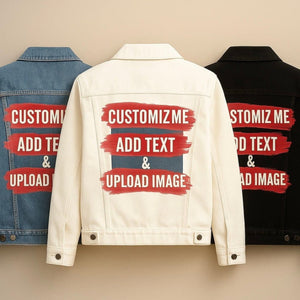
On stonewashed denim, the wave softens into something atmospheric. Blues and whites diffuse into the fabric grain, foam edges rounding and blending. The noodles deepen into warmer golds, their separation less crisp but more cohesive. The red bowl becomes slightly muted, reading as worn ceramic rather than glossy lacquer.
The Japanese characters and seal blur gently, feeling stamped into the fabric rather than printed on top. Emotionally, the artwork shifts toward comfort and familiarity—the ramen feels nourishing, the wave remembered rather than crashing.
Stonewashed denim makes Great Ramen Wave feel like a beloved image revisited, where drama settles into warmth.
On white denim, clarity takes hold. The wave’s foam becomes sharply defined, each curl and spray legible. The noodles snap into crisp parallel lines, and the egg yolk glows vividly. The red bowl pattern reads clean and graphic, and the chopsticks stand out boldly.
The Japanese text and seal become strong design anchors. Emotionally, white denim presents the artwork as energetic and celebratory—a playful collision of tradition and appetite rendered in full light.
On black denim, the scene becomes dramatic and iconic. The background disappears entirely, allowing the wave and noodles to glow forward. Blues deepen, whites brighten, and the golden noodles feel almost luminous. The red bowl and chopsticks intensify, framing the composition with heat and richness.
Emotionally, black denim transforms Great Ramen Wave into a bold nocturnal emblem—powerful, indulgent, and theatrical—where motion and appetite collide in a single, unforgettable image held close against darkness.