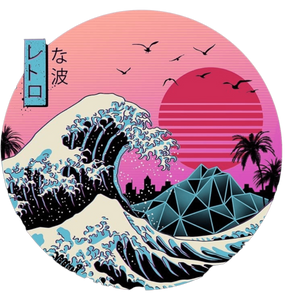
A circular retro-style ocean scene with a large cresting wave in blue, white, and black filling the left side, dotted with white foam. A pink sunset sky with horizontal stripes frames a red sun on the right, silhouetted birds flying overhead. A dark city skyline and palm trees sit along the horizon, while a geometric teal mountain shape rises from the water. Vertical Japanese characters appear on the left. This artwork is titled “Great Retro Wave” and created by Vincent Trinidad
The wave breaks the circle with intention. The crest rises from the left edge, its white foam curling inward in thick, graphic shapes outlined by deep black water beneath. The wave’s interior is speckled with tiny white dots, like stars suspended in liquid, giving the water a night-sky density rather than transparency. The foam claws outward in layered arcs, each curve stacked tightly, frozen at the moment before collapse.
As your eye follows the curve downward, the water settles into rhythmic bands. Dark navy and black stripes flow horizontally, interrupted by pale blue highlights that trace motion without softening it. The wave’s base sweeps across the lower portion of the circle, anchoring the composition and guiding the eye toward the right.
The sky asserts itself with contrast. A gradient of warm pinks fills the upper background, overlaid with thin horizontal lines that give the surface a subtle scanline texture. On the right, a red sun sits low and heavy, its surface divided by evenly spaced horizontal bands that echo the sky’s lines. Black bird silhouettes arc across the sky, spaced irregularly, suggesting distance and scale without detail.
At the horizon, geometry replaces nature. A dark city skyline cuts a jagged line across the center, its buildings simplified into blocky silhouettes. Palm trees rise at either side, their fronds thin and angular, framing the urban edge. Just below the skyline, a faceted teal mountain form emerges from the water, composed of triangular planes outlined in pale lines, its rigid geometry contrasting sharply with the organic wave beside it.
A shift in tone happens when you notice the typography. On the left side of the circle, vertical Japanese characters sit within a pale blue rectangular panel. The characters are bold and graphic, their strokes clean and uniform, reinforcing the poster-like quality of the piece. They do not explain the scene; they label it, like a title stamped onto a print.
The entire image is contained within a perfect circle, floating against a black background. There is no foreground beyond the wave, no background beyond the sky. The circle reads like a vinyl record, a badge, or a portal—self-contained and deliberate.
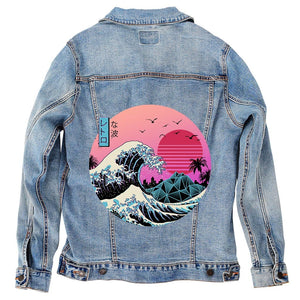
On stonewashed denim, the colors soften into nostalgia. The pink sky diffuses into warmer tones, and the red sun loses sharp banding, becoming more atmospheric. The wave’s foam blends into the denim grain, rounding its edges and reducing contrast between black water and white spray.
The geometric mountain becomes subtler, its lines less rigid, and the skyline recedes gently. Emotionally, the artwork shifts toward memory—a retro dreamscape worn smooth by time.
Stonewashed denim makes Great Retro Wave feel like an old poster rediscovered, its edges softened but its mood intact.
On white denim, clarity takes command. The wave’s black-and-white contrast sharpens, each foam claw clearly defined. The pink sky and red sun pop vividly, their horizontal lines clean and graphic. The skyline and mountain read distinctly, emphasizing the collision of nature, city, and design.
Emotionally, white denim presents the artwork as bold and playful—a clean retro statement with confident color and form.
On black denim, the scene becomes cinematic and electric. The background disappears entirely, allowing the circle to glow. The wave’s highlights intensify, the red sun burns brighter, and the pink sky deepens toward magenta. Birds and skyline silhouettes feel suspended in night.
Emotionally, black denim transforms Great Retro Wave into a nocturnal icon—stylized, surreal, and immersive—where motion, nostalgia, and geometry collide in a single, self-contained world held close against darkness.