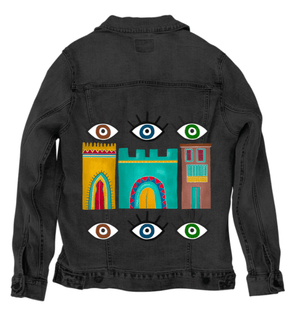
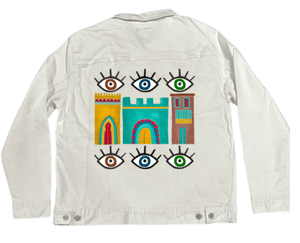
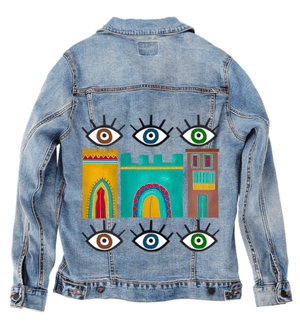
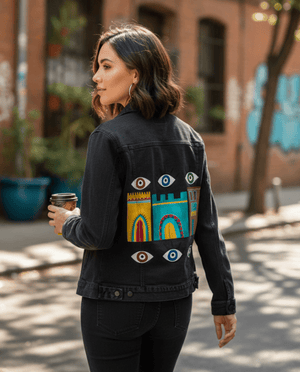
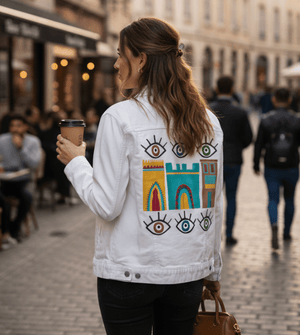
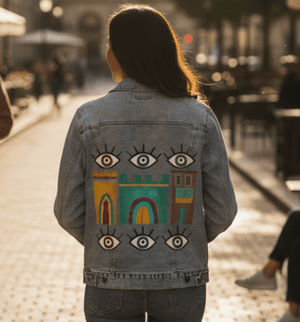
Three stylized houses arranged side by side on a transparent background, painted in flat saturated colors with visible brush texture. Above and below the houses are six almond-shaped eye symbols with white sclera, dark outlines, short radiating lashes, and irises in brown, blue, and green. The left house is mustard yellow with a central arched doorway outlined in teal and red, the center house is turquoise with a crenelated roofline and a bold arched doorway bordered by red triangles, and the right house is warm brown with teal and red window and door details. This artwork is titled “Houses” and created by Hend Shehata
The composition settles immediately into order. Three houses stand upright across the center, evenly spaced, their bases aligned along an invisible ground that never fully appears. Each structure is simplified into strong geometric blocks, painted with matte, opaque color that still reveals faint brush texture beneath. The surfaces feel solid and intentional, with no gradients — color is applied confidently, holding its shape.
The left house rises in mustard yellow, its top edge capped with a decorative band of red and teal patterning. At its center, a tall arched doorway pulls the eye inward. The arch is layered: teal outer edges, yellow interior, and a deep red vertical shape running down the middle. Short radiating lines surround the arch like small strokes of emphasis, evenly spaced and precise, creating a focal point that feels watched rather than entered.
The central house anchors the scene. It is wider and painted in turquoise, its roofline cut into square crenellations that resemble a simplified fortress edge. Across the upper portion runs a thin yellow band dotted with small white marks, a measured rhythm across the facade. The doorway is arched again, but bolder — framed by alternating red triangles that form a sharp zigzag halo around a yellow interior. The symmetry here is deliberate, the shapes crisp and contained.
On the right, a tall brown house narrows the composition. Rectangular windows stack vertically, each filled with teal panels crossed by red horizontal lines. Below, a slim door echoes the same palette, teal outlined with red. The verticality of this house contrasts the broader central structure, creating variation without breaking balance.
Above and below the houses, eyes repeat in a strict pattern. Three hover above, three below, aligned directly with the structures beneath them. Each eye is almond-shaped with a white interior, thick dark outline, and short, blunt lashes radiating outward. The irises shift in color — warm brown, deep blue, and green — repeating the sequence top and bottom. These eyes do not move, but their placement creates tension, as if the houses exist under constant observation.
Negative space is decisive. The transparent background isolates each element, keeping houses and eyes suspended without overlap. Nothing crowds. Every symbol has room to breathe, yet the vertical alignment binds them together. The overall effect is structured, watchful, and contained.
On stonewashed denim, the rigid geometry softens. The edges of the houses blur slightly as pigment settles into the worn twill. Mustard yellow and turquoise mellow into the fabric’s blue-gray undertone, and the crisp red accents lose some sharpness.
The eyes on stonewashed denim feel less confrontational. Their outlines relax, lashes diffusing into softer marks. Emotionally, the scene shifts toward familiarity — still watchful, but gentler, like a neighborhood remembered rather than surveyed.
Stonewashed denim gives the artwork a lived-in calm. The houses feel settled, and the gaze above and below becomes protective rather than intense.
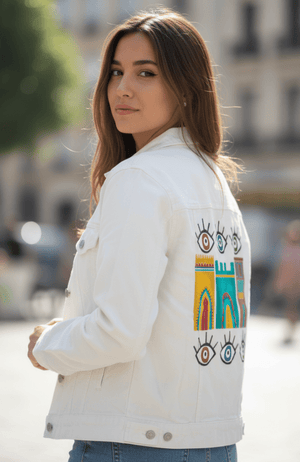
On white denim, clarity asserts itself. Every edge sharpens: crenellations snap into focus, zigzag triangles become precise, and window lines read cleanly. The contrast between mustard, turquoise, brown, red, and teal becomes crisp and graphic.
The eyes regain their full presence. Each iris color reads clearly, and the repetition feels intentional and emblematic. Emotionally, the artwork feels declarative and alert, like a visual statement of structure and awareness.
White denim frames the piece like a symbol. The houses feel iconic, and the gaze feels direct and unambiguous.
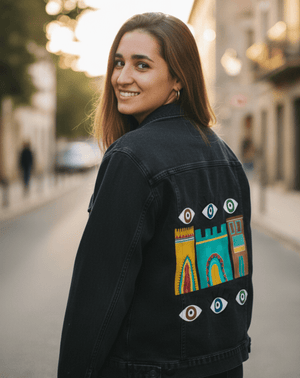
On black denim, the composition compresses into intensity. Colors deepen and glow — turquoise becomes richer, red accents feel warmer, and the mustard yellow gains weight. The houses appear heavier, more fortified.
The eyes emerge strongly against the dark base. White sclera glow, irises deepen, and lashes feel sharper. Negative space collapses into depth, making the gaze feel closer and more insistent. Emotionally, the piece becomes cinematic and guarded.
Black denim transforms the artwork into something protective and powerful. The houses feel watched, but also defended, held tightly within shadow.
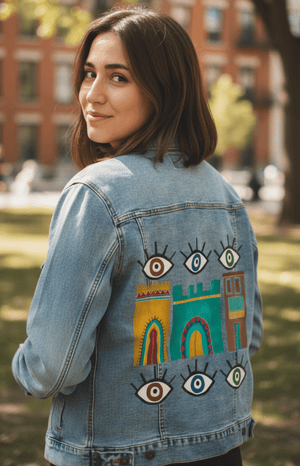
On classic blue denim, balance returns. The turquoise house harmonizes naturally with the fabric, while mustard and brown rise forward just enough to remain distinct. Pigment settles evenly into the twill, preserving shape without harsh contrast.
The eyes integrate smoothly, their blues especially resonant with the base fabric. The repetition feels steady rather than tense. Emotionally, the artwork feels grounded and composed.
Classic blue denim gives the piece a timeless, wearable presence. The houses feel stable, the gaze feels calm, and the entire composition rests in quiet equilibrium — structured, aware, and at home within the fabric.