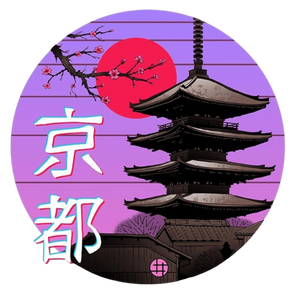
A circular scene showing a traditional Japanese pagoda in dark silhouette on the right, layered with multiple roof tiers and a tall spire. A large red sun sits behind the structure against a lavender-to-pink sky with thin horizontal lines. A cherry blossom branch with small pink flowers extends from the upper left. Vertical Japanese characters appear on the left in white with cyan and pink outlines. Rooftops and wooden buildings sit at the base. the background outside the circle is black. This artwork is titled “Kyoto Wave” and created by Vincent Trinidad
You drift first
into the stillness of the pagoda, because it holds the entire composition in balance. The structure rises vertically on the right side of the circle, its stacked roofs layered one above another, each eave slightly curved and sharply defined. The silhouette is dark and solid, broken only by thin highlights along roof edges and faint texture that suggests aged wood and tile. The spire extends upward in a tight, repeating rhythm, anchoring the building firmly within the circle.
Behind it, the red sun asserts itself as a perfect disc. It sits slightly off-center, heavy and unmoving, its surface uninterrupted by texture. Thin horizontal bands cut across the sky in front of it, soft lavender and pink lines that flatten space and introduce a retro graphic quality. The sun does not glow outward; it presses forward through contrast alone, dominating the background without overwhelming the architecture.
Your eye moves leftward, where a cherry blossom branch reaches inward from the edge of the frame. The branch is dark and angular, its offshoots thin and irregular. Small pink blossoms punctuate the line, each flower rendered simply with soft petals and darker centers. The blossoms feel suspended, not falling, as if time has paused to hold them in place.
A shift in visual language happens when you notice the typography. Vertical Japanese characters sit on the left side of the circle, bold and graphic. The strokes are white, outlined with cyan and pink shadows that create a slight offset effect, giving the text depth without realism. The characters float cleanly against the sky, acting as a design element rather than narrative explanation.
At the base of the scene, traditional rooftops and wooden buildings form a low horizon. Their shapes are simplified but detailed enough to suggest beams, tiles, and walls. A small round window glows faintly, adding a quiet point of human presence beneath the towering pagoda. The ground is implied rather than drawn, keeping focus upward.
The entire scene is contained within a clean circular boundary. Outside the circle is pure black, isolating the image like a badge, a vinyl record, or a portal. There is no transition between circle and background—just a clean edge that reinforces containment and intention.
The color palette is controlled and deliberate. Deep blacks and charcoals anchor the architecture. Red, pink, and lavender dominate the sky. Cyan accents appear only in outlines and small details, preventing the scene from becoming overly soft. Texture appears as grain and subtle wear rather than painterly blending.
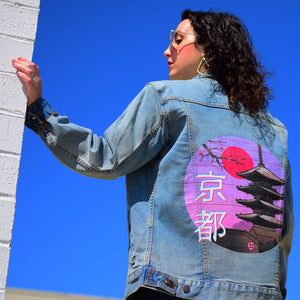
On stonewashed denim, the scene softens into atmosphere. The lavender and pink sky diffuses into the worn twill, blending the horizontal lines into a gentle haze. The red sun deepens into a muted crimson, less graphic and more nostalgic. The pagoda’s silhouette loses some edge sharpness, feeling older and more weathered.
The cherry blossoms on stonewash become gentler, their pinks warming and blending into the fabric grain. The Japanese characters soften at their outlines, reading more like stamped marks than glowing text. Emotionally, the artwork shifts toward memory—Kyoto recalled rather than observed.
Stonewashed denim makes Kyoto Wave feel timeless and reflective, like a place carried quietly within.
On white denim, clarity takes hold. The circle reads clean and bold. The pagoda silhouette becomes crisp and architectural, each tier clearly defined. The red sun pops strongly against the pale base, and the horizontal sky lines become graphic and precise.
The cherry blossoms brighten, and the cyan-and-pink outlines on the characters stand out sharply. Emotionally, white denim presents the artwork as intentional and iconic—a clean, modern homage to tradition and design.
On black denim, the image becomes intimate and cinematic. The background disappears entirely, causing the circle to glow forward. The red sun intensifies, and the lavender sky deepens toward violet. The pagoda feels monumental, emerging from darkness with quiet authority.
The cherry blossoms and text float like illuminated accents. Emotionally, black denim transforms Kyoto Wave into a nocturnal vision—contained, reverent, and powerful—where tradition, design, and stillness coexist in a single suspended moment.