A
seated white beckoning cat with rounded body, large amber eyes, pink inner
ears, and small whiskers, holding a pair of wooden chopsticks raised in one
paw. The cat wears a red collar with a gold bell and a green bib, and rests the
other paw on a round sushi roll showing orange, green, and red fillings. Orange
patches mark the legs and sides. a knotted headband wraps across the forehead.
vertical red Japanese characters appear to the left. Thick black outlines and
grainy texture sit against a dark background. this artwork is titled “Manseki
Sushi” and created by Pepe Rodriguez aka ppmidThe
cat’s face is centered and calm. The head is round and evenly proportioned,
with large almond-shaped eyes set wide apart and filled with warm amber color.
Each eye carries a soft gradient, darker near the upper edge and lighter toward
the lower curve, giving them depth without shine. The nose is small and pink,
triangular and centered, with a short vertical line leading down to a simple
mouth. Thin whiskers extend outward in pairs, lightly etched against the pale
fur.
Your
gaze moves upward and outward to the ears and headband. The ears are upright
and symmetrical, their interiors filled with muted red that contrasts gently
against the white fur. A fabric headband wraps horizontally across the
forehead, patterned with alternating tan and orange bands and tied into a knot
on the left side. The knot’s tails angle diagonally upward, adding motion to an
otherwise grounded pose. The headband sits just below the ear bases,
compressing the fur slightly where it rests.
Then
the body settles into view. The cat sits squarely, legs tucked beneath a
rounded torso. Soft orange patches appear on the arms and legs, irregular in
shape and softly blended at the edges. A red collar circles the neck, dotted
with small white marks and centered by a round gold bell that catches a hint of
highlight. Below it, a green bib covers the chest, its edges clearly defined by
thick outlines.
The
focal action happens at the paws. One paw rests firmly atop a large sushi roll
positioned at the center bottom of the composition. The roll’s outer rice ring
is pale and textured, enclosing bold interior shapes: a curved orange section,
a green wedge, and a deep red form, each separated by clean lines. The other
paw lifts a pair of wooden chopsticks straight upward, held together near their
midpoint. The chopsticks are long and slender, striped with orange bands near
the tips, and extend beyond the cat’s head, breaking the vertical boundary of
the figure.
A
shift in mood happens when you notice the surrounding marks. To the left of the
cat, vertical red Japanese characters run downward, rendered with slightly
rough edges that match the grain of the illustration. A small circular emblem
appears beneath them. These elements balance the raised chopsticks on the
right, creating a visual symmetry that frames the cat without enclosing it.
The
entire image is unified by texture. Thick black outlines contain every form,
while the interior colors carry a soft grain, as if printed ink has settled
unevenly. Shadows are minimal and stylized, placed just beneath the paws, along
the belly curve, and under the sushi roll, grounding the figure without
anchoring it to a physical surface. The background remains dark and empty,
allowing the cat and its objects to exist in isolation.
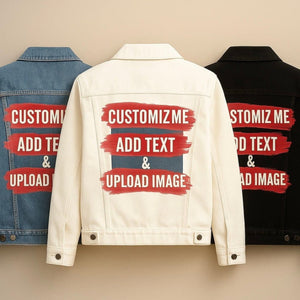
On
stonewashed denim, the white fur immediately softens, absorbing into the worn
twill so the edges of the body blur gently into the fabric. The amber eyes lose
some sharpness, becoming warmer and more subdued. The red collar and headband
diffuse slightly, their colors settling into the denim grain like something
aged and familiar.
The
sushi roll’s interior colors blend more subtly on stonewash. The orange and
green fillings soften at their borders, and the rice ring feels less crisp,
more tactile. The Japanese characters to the left become less assertive, their
strokes blending into the fabric’s texture.
Emotionally,
stonewashed denim turns the scene into something comforting and lived-in. The
cat feels less like a graphic figure and more like a familiar companion, its
steady pose reinforced by the softened surface beneath it.
On
white denim, clarity takes control. The cat’s white fur reads clean and bright,
sharply separated from the orange patches. The amber eyes regain their
contrast, pulling focus directly to the face. The headband’s stripes and knot
become crisp, and the chopsticks read as precise, straight lines.
The
sushi roll becomes a vivid centerpiece. Each interior color is clearly defined,
and the rice ring stands out with graphic precision. The red Japanese
characters appear bold and legible, acting as a strong vertical counterweight
to the raised chopsticks.
Here,
the emotion shifts toward confidence and presentation. White denim frames the
artwork like a clean display surface, making the cat’s pose feel intentional
and declarative, every element clearly stated.
On
black denim, the composition compresses inward. The white fur glows softly
against the dark base, especially along the cheeks, paws, and belly. The orange
patches deepen, and the amber eyes feel closer and more intimate. The
chopsticks stand out as pale vertical lines cutting through darkness.
The
sushi roll becomes jewel-like, its interior colors glowing against the black
fabric. The red collar and headband intensify, creating warm points of color
near the face. The Japanese characters recede slightly, their red strokes
merging into shadow while still providing structure.
Emotionally,
black denim turns the scene cinematic and intimate. The cat feels contained
within the darkness, its calm expression and steady grip on chopsticks drawing
you closer, as if the moment is held quietly just for you.