Four
anthropomorphic brown bears posed on a round gray pedestal against a black
background. one bear sits centered on a gold-trimmed throne wearing a black
suit, bow tie, and crown, holding a smaller bear figure. Three standing bears
flank the throne wearing different outfits: a green jacket with patches and
beanie, a blue varsity-style jacket with a red headband, and a red patterned
robe with matching headwrap. Pale fabric rises behind them like a draped
backdrop, and scattered pink and red petals fall at the base. This artwork is
titled “Moving To America” and created by The Nygerians
This
composition reads like a staged moment frozen in place. Four bears stand and
sit on a circular pedestal, evenly spaced, facing forward. The central bear
occupies a gold-trimmed throne, posture upright and composed, paws resting
firmly. The throne’s vertical slats and armrests frame the figure, giving it
visual authority without exaggeration. The small bear figure held close to the
chest adds a second scale within the center, creating intimacy inside
formality.
Your
eye moves outward to the flanking figures. On the left, a bear in a green
jacket stands with feet planted apart, jacket covered in small patches and
symbols. A knit beanie sits low on the head, softening the silhouette. Next to
it, another bear wears a blue varsity-style jacket and a red headband marked
with text, the jacket’s stripes and panels creating strong horizontal breaks
across the torso. On the right, a bear dressed in a red patterned robe stands
tall, fabric falling straight and heavy, paired with a matching headwrap that
rises slightly above the ears.
A
shift in texture happens when you notice the backdrop. Behind the group, a pale
fabric form rises like a curtain or sculpted drape, its folds soft and
irregular. It does not touch the figures; instead, it hovers behind them,
suggesting ceremony rather than environment. The background beyond remains
completely black, isolating the group and heightening their presence.
The
pedestal grounds everything. It is rendered in muted gray tones, slightly
beveled at the edges, with subtle shading that suggests weight and solidity. At
the base, small red and pink petals scatter outward, some overlapping the
pedestal’s edge, others falling freely into the empty space below. These
scattered shapes break the rigidity of the pose with gentle motion.
Linework
remains clean and illustrative. The bears’ fur is simplified into smooth brown
tones with minimal texture, allowing clothing, posture, and placement to carry
meaning. No shadows extend beyond the figures; the scene exists in a
controlled, symbolic space rather than a physical room.
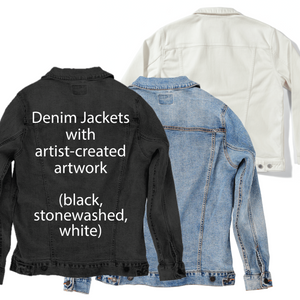
On
stonewashed denim, the colors settle and soften. The green jacket and blue
varsity coat mute into calmer tones as pigment sinks into the worn twill. The
red robe deepens into a richer, earthier shade. Edges blur slightly, making the
figures feel less rigid and more unified.
The
pale backdrop diffuses into the denim grain, its folds becoming more
atmospheric. The petals at the base blend into the fabric texture, reading like
embedded memory rather than active motion. Emotionally, the scene shifts toward
reflection—roles and identities carried over time rather than declared at once.
Stonewashed
denim makes Moving To America feel lived-in and contemplative. The
figures feel like they have stood there for a long time, their presence steady
and enduring.
On
white denim, clarity takes hold. Each outfit reads sharply: jacket patches
become distinct, varsity stripes clean, robe patterns crisp. The gold of the
throne stands out clearly against the white base, reinforcing the central
figure’s position. The smaller bear held at center becomes an unmistakable
detail rather than a subtle one.
The
pale backdrop contrasts cleanly, its folds clearly visible, and the falling
petals appear deliberate and graphic. Emotionally, white denim presents the
artwork as declarative and present—a moment of arrival held in full light.
On
black denim, the composition compresses inward. The background disappears
entirely, causing the figures to emerge from darkness. The throne’s gold trim
and the red robe glow subtly, while the bears’ brown fur deepens. The petals
become small points of color suspended below.
The
central figure feels more pronounced, the group reading as a single, contained
unit. Emotionally, black denim transforms Moving To America into a quiet
statement of presence—formal, grounded, and resolute—held close against shadow,
where identity and position are asserted without noise.