illustration
of a bright red octopus riding a light blue bicycle, its long curling tentacles
looping outward and around the frame and wheels. pale suction cups line the
undersides of each arm, and one large eye looks forward with calm focus. the
bicycle features thin gray wheels, a black seat, and a small white bottle
attached to the frame, set against a clean white background. this artwork is
titled “Octopus Riding a Bicycle” and created by Amelia Legault
You
drift first into the outward curl of the tentacles, each arm unfurling in a
different direction as if testing the air. The octopus sits astride the bicycle
with impossible confidence, its body centered above the frame while motion
radiates outward through spirals and loops. The scene holds a precise kind of
balance — the stillness of a paused ride paired with the suggestion of movement
everywhere else. Nothing feels frantic. Everything feels controlled.
Your
eye follows the tentacles one by one. Some arc upward in open curves, others
coil tightly inward, and a few reach down to wrap the bicycle frame itself.
Along the undersides, rows of pale suction cups appear as small, evenly spaced
dots, growing slightly smaller as they travel toward the tips. A faint
thickening of red pigment surrounds each cup, giving them subtle dimensional
lift. On denim, these dots settle into the weave, breaking into tiny
constellations of texture. That matters because the tentacles stop feeling flat
and start feeling tactile — like living limbs gripping air and metal at once.
A
shift in mood happens when you reach the head. The red surface is smoother
here, with brush strokes flowing downward in gentle vertical sweeps rather than
tight curls. A single eye anchors the form, outlined cleanly and positioned
slightly forward, giving the octopus quiet awareness rather than surprise. The
eye does not chase motion; it observes it. You can almost feel the calm
concentration of balance — the internal stillness required to keep everything
upright.
Then
comes a new kind of rhythm in the bicycle itself. The light blue frame curves
simply beneath the octopus, its lines clean and evenly filled, offering
structure against the organic chaos above. The gray wheels are lightly
sketched, their thin spokes suggesting rotation without demanding it. One
tentacle loops near the handlebars, another drapes near the pedals, creating a
visual dialogue between body and machine. The bicycle doesn’t fight the octopus
— it accommodates it.
Color
becomes emotion in the contrast between red and blue. The octopus glows with
warmth, its reds shifting between coral, crimson, and hints of orange where
strokes overlap. The bicycle remains cooler and steadier, a quiet
counterbalance. This temperature difference gives the scene its emotional
clarity: imagination held by structure, playfulness carried by control.
The
white background removes all distraction. There is no horizon, no ground, no
destination — only the act of riding itself. The space feels like air, allowing
the tentacles to breathe outward without resistance. It’s a moment of motion
existing purely for its own pleasure.
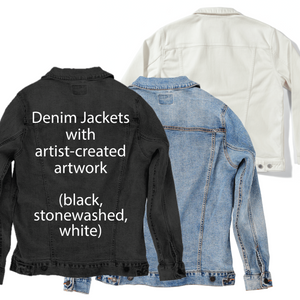
When
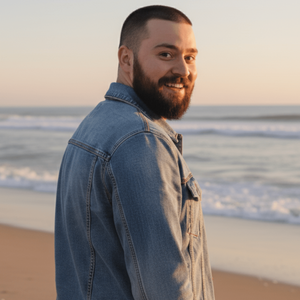
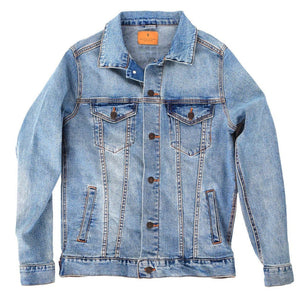
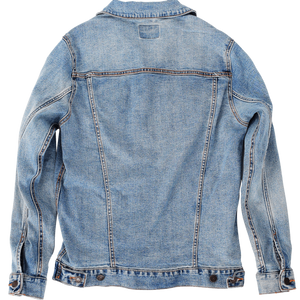
this artwork lives on stonewashed denim, the red of the octopus softens and
spreads slightly, especially along the tentacles where pigment sinks into the
worn grain. The suction cups blur just enough to feel embedded rather than
printed, turning their repetition into a gentle texture you can almost feel
under your fingers. As the jacket moves, light skips unevenly across the
softened reds, making the tentacles feel fluid, like they’re still in motion.
On
stonewash, the blue bicycle warms subtly, losing a bit of crispness as its
edges relax into the fabric. The contrast between creature and frame becomes
more harmonious, more nostalgic. The scene feels like a memory of movement
rather than movement itself — playful, easy, unforced.
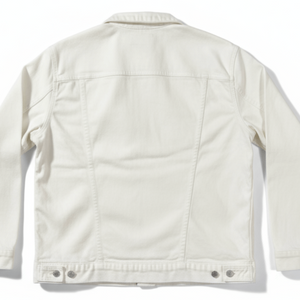
On
white denim, everything sharpens. The suction cups separate cleanly, each dot
distinct, their pale rims crisp against the red arms. The brush direction in
the tentacles becomes more visible, revealing the careful flow of each curve.
The eye gains clarity and focus, anchoring the composition with intention. The
octopus feels alert here — curious, clever, alive.
The
blue bicycle on white denim reads bright and buoyant, its curves clearly
defined. The wheels feel lighter, almost floating, and the white space
amplifies the sense of air around the scene. As the jacket moves, contrast
stays steady, giving the artwork an energetic, playful presence that feels bold
without being loud.
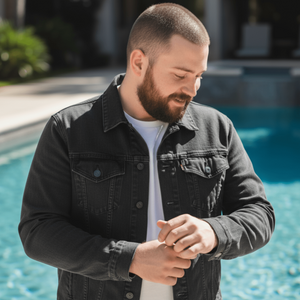
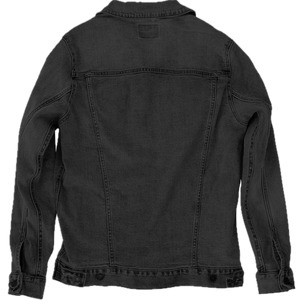
On
black denim, the scene deepens dramatically. The red octopus compresses into
richer tones, its highlights glowing softly while deeper reds sink into the
dark base. The tentacles feel heavier here, more sculptural, their curls
pulling inward visually. The suction cups become points of light, punctuating
the darkness like tiny signals of grip and control.
The
blue bicycle on black denim becomes a luminous counterline, cutting through the
dark with calm precision. As the jacket bends and folds, flashes of red and
blue emerge and disappear, creating a cinematic rhythm. The moment feels
intimate and surreal — a quiet ride through imagination itself, carried close
to the body, balanced perfectly between motion and stillness.