A
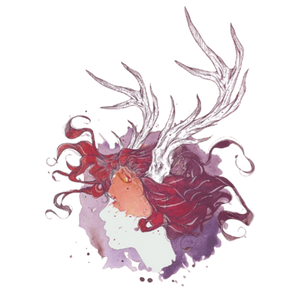
woman’s side-profile facing left with closed eye and pale skin, her long red
hair flowing outward in thick, curling strands. white branching antlers rise
from her head, textured with fine grain lines. Behind her head sits a loose
circular wash of lavender and muted purple watercolor with soft edges and
scattered droplets. The figure is outlined with delicate ink linework. This
artwork is titled “Pagan Queen” and created by Jess Adams
You
drift first into the profile, clean and unmistakable. The woman’s face is shown
in calm side view, nose gently sloped, lips softly closed, eye lowered and at
rest. Her skin is rendered in pale tones with minimal shading, allowing the
linework to define form rather than depth. The outline is delicate but
confident, tracing the jaw, cheek, and brow with steady precision. There is no
background clutter here — the face exists clearly, suspended in quiet.
Then
the hair takes over the space. Thick red strands pour backward from the crown,
curling and looping into themselves. The linework varies in thickness,
tightening around bends and loosening where strands fan outward. Color pools in
places, deepening into wine and rust tones, then thins toward the ends where
watercolor becomes translucent. Small splatters break free from the main mass,
dotting the surrounding space and giving the hair a sense of movement held
mid-flow.
From
the top of her head, antlers rise — pale, branching, and textured. Each tine
twists upward with subtle variation, their surfaces marked by fine grain lines
that suggest ridges without exaggeration. The antlers extend higher than the
hair, cutting cleanly into the surrounding negative space. Their color stays
light and restrained, standing apart from the saturated reds below. The
contrast is structural rather than symbolic — bone-like form against fluid
hair.
Behind
everything, a loose circular wash of lavender and muted purple anchors the
composition. Its edges are uneven and soft, with watercolor blooms and lighter
patches where pigment thins. This shape does not frame tightly; it breathes
outward, allowing drips and spots to escape below. The face overlaps the wash
slightly, flattening depth and keeping all elements pressed into the same
visual plane. Stillness settles here — hair in motion, antlers rising, face
unmoving.
On
stonewashed denim, the watercolor wash softens first. Lavender and purple
pigments sink into the worn twill, spreading outward and blurring the circle’s
edge. The background feels atmospheric, like a memory rather than a shape.
Emotionally, the piece shifts toward age and quiet continuity.
The
red hair on stonewash becomes velvety. Individual strands lose some sharp
separation as pigment diffuses, creating a unified mass of warmth. The antlers
soften slightly at their edges, integrating into the garment. The overall
feeling becomes grounded and lived-in, motion remembered rather than immediate.
On
white denim, clarity asserts itself. The woman’s profile becomes crisp and
graphic, with clean contrast between skin and linework. Hair strands separate
distinctly, and the reds feel brighter and more intentional. The antlers appear
sharply defined, their branching structure unmistakable.
The
watercolor circle on white denim reads as deliberate and luminous. Pools,
splatters, and lighter patches stand out clearly. Emotionally, this version
feels declarative and present — calm, controlled, and fully visible.
On
black denim, the artwork compresses into intimacy. The pale face and antlers
glow softly against the dark base, while the red hair deepens into richer,
heavier tones. Strands feel closer, denser, and more enclosed.
The
purple wash recedes into shadow on black denim, becoming a muted halo rather
than a backdrop. Drips appear heavier and slower. Emotionally, the piece turns
inward — restrained, powerful, and quietly intense, as if carried close rather
than shown outward.