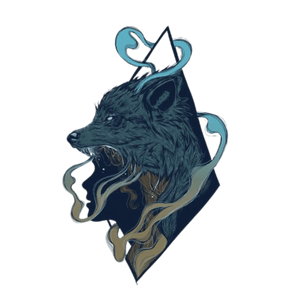
A
wolf’s head in side profile facing left, rendered in deep blue and charcoal
tones with dense, directional fur linework. the wolf’s eye is small and light,
and its mouth is slightly open, showing a dark interior. Flowing pale blue and
tan ribbon-like shapes curl around and through the head. A dark, angular
geometric form sits behind the wolf, partially intersected by looping lines.
this artwork is titled “Skinwalker” and created by Jess Adams
You
drift first into the wolf’s profile, sharp and unmistakable. The head faces
left, muzzle extended, jaw slightly open as if caught mid-breath. Fur is built
from dense, directional strokes that follow the skull’s structure — short,
tight lines around the snout and eye, lengthening and thickening along the
cheek and neck. The color stays within deep blues and charcoals, layered so
closely that the surface feels heavy and compact rather than soft. The eye is
small and pale, set deep into the face, pulling attention inward rather than
outward.
A
shift in motion happens where the fur gives way to flowing shapes. Pale blue
and muted tan ribbons coil around the wolf’s head, slipping behind the jaw,
looping upward, then reemerging along the neck. These forms are smooth and
fluid, their edges clean but organic, contrasting sharply with the fur’s rough
texture. They do not sit on the surface; they thread through the composition,
creating depth without perspective. Their curves introduce movement that the
wolf itself refuses to make.
Behind
the head, a dark angular geometric form rises — sharp-edged and faceted, angled
slightly backward. It frames the wolf without enclosing it, its flat planes
absorbing light rather than reflecting it. The wolf overlaps this shape,
breaking its edges and flattening the space so geometry and animal occupy the
same visual layer. Thin looping lines extend above and around the shape,
curling into open air and returning back toward the form, like motion caught
and redirected.
Stillness
defines the emotional core. The wolf does not snarl or lunge. The open mouth
feels restrained, not aggressive. Line density increases along the jaw and
neck, where weight gathers, while the ribbon-like forms remain light and
unanchored. The contrast between mass and flow creates tension that stays
unresolved — presence without action, power held rather than released.
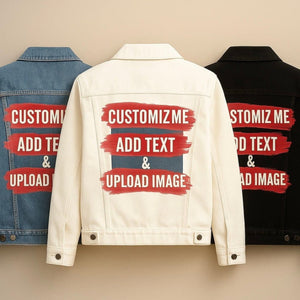
On
stonewashed denim, the wolf’s fur softens immediately. Pigment sinks into the
worn twill, blurring the tight linework and merging individual strokes into
broader shadowed areas. The head feels older here, less sharp, as if shaped by
time rather than edge. Emotionally, the piece shifts toward endurance and quiet
vigilance.
The
flowing ribbons on stonewash diffuse gently, their edges feathering into the
fabric’s grain. Pale blues and tans blend into the denim, reducing contrast and
creating a dreamlike continuity. The geometric shape behind the wolf recedes,
becoming atmospheric rather than structural, and the overall mood turns
reflective and worn-in.
On
white denim, clarity takes control. The wolf’s fur lines separate cleanly,
revealing the precision of the stroke direction and density. The eye becomes
more pronounced, and the open mouth reads clearly as a controlled opening
rather than motion. Emotionally, the wolf feels alert and present, its
restraint more deliberate.
The
ribbons on white denim appear crisp and intentional, their curves clearly
defined against the bright base. The dark geometric form sharpens into a strong
anchor, emphasizing contrast between organic and angular. This version feels
declarative and focused, with tension held tightly in place.
On
black denim, the artwork compresses into intimacy. The wolf’s dark fur blends
closely with the fabric, allowing highlights along the muzzle, eye ridge, and
ear to emerge selectively. The head feels closer and heavier, as if pressed
into shadow.
The
pale ribbons glow softly against the black, becoming the primary movement in
the composition. The geometric form deepens and recedes, acting as a silent
mass behind the wolf. Emotionally, this colorway feels guarded and inward —
power contained, motion suppressed, the image carried close rather than shown
outward.