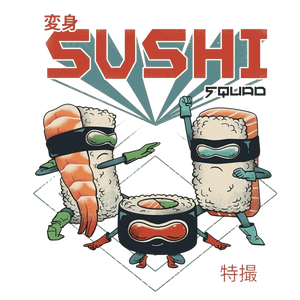
Three anthropomorphic sushi characters dressed like masked superheroes, posed in dynamic stances against a black background. Two tall sushi pieces flank a round maki roll at center, each with black eye masks, colored gloves, boots, and belts. Bold red text reading “SUSHI” appears at the top with angular rays behind it, accompanied by smaller Japanese characters and the word “SQUAD.” Additional Japanese text appears near the corners. This artwork is titled “Sushi Squad” and created by Vincent Trinidad
This scene is built around symmetry and stance. Three sushi characters stand arranged in a triangular composition, the central figure slightly forward, the flanking figures angled inward. The geometry beneath them — thin white lines forming a diamond frame — anchors their positions like a stage or emblem. Nothing feels accidental; every body is placed with intention.
The center character is a round maki roll, squat and compact, its rice textured with small off-white speckles and wrapped in a thick black band of nori. A red oval visor sits across its face, glossy and reflective, giving it a focused, almost stoic expression. Short legs extend below, boots planted wide, arms outstretched in readiness rather than attack. This figure feels like the core — grounded, balanced, and stable.
On the left, a tall piece of shrimp nigiri leans forward in motion. The orange shrimp curves down the side, segmented and striped, its tail hanging like a cape caught mid-swing. The rice beneath is thick and textured, with uneven edges that contrast the smooth shrimp surface. One green-gloved arm extends outward in a dramatic pointing gesture, while the other arm pulls back, suggesting momentum. The stance is athletic and aggressive, frozen mid-action.
On the right, a tall rice roll mirrors the left in height but not in movement. This figure raises a clenched fist upward in a classic victory pose, elbow bent, chest lifted. The rice texture is more uniform, the nori band snug, and the visor matches the others in shape but reflects light differently, giving the trio subtle individuality. The boots and gloves are cooler-toned, reinforcing balance across the composition.
Above them, typography explodes outward. The word “SUSHI” dominates the top in bold red block letters, slightly distressed with grain and texture. Angular teal rays burst downward from behind the text, converging toward the center character, visually linking title and team. To the right, the word “SQUAD” appears in smaller stylized lettering, compact and controlled, like a subtitle.
Japanese characters punctuate the scene in multiple locations — top left, right of the title, and bottom right — printed in red and off-white with rough edges. They function as graphic stamps rather than readable narrative, reinforcing the tokusatsu / retro action aesthetic. The overall palette blends warm reds and oranges with cool teals and greens, balanced carefully so no single element overwhelms.
The background is pure black. There is no environment, no setting, only characters and symbols suspended in space. This absence elevates the trio into icons — not sushi on a plate, but sushi as heroes.
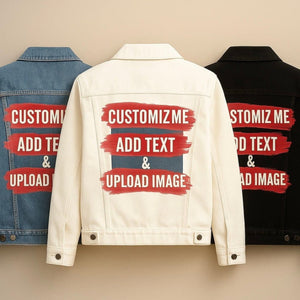
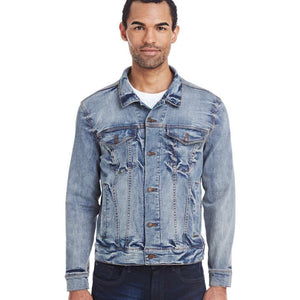
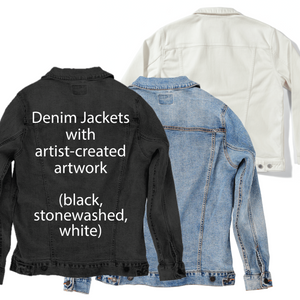
On stonewashed denim, the entire scene softens into nostalgia. The reds of the title deepen into brick tones, and the teal rays diffuse into the fabric grain, losing sharp edges but gaining warmth. The rice textures blend beautifully with the denim weave, becoming more organic and less graphic.
The characters feel less like action figures and more like mascots remembered from childhood. Emotionally, the piece shifts toward playful familiarity — teamwork remembered rather than posed.
Stonewashed denim makes Sushi Squad feel like a beloved retro series, worn into the fabric through repetition and affection.
On white denim, clarity takes full control. The red “SUSHI” text pops boldly, and the teal rays become crisp and directional. Each sushi character reads cleanly: shrimp segmentation, rice texture, nori bands, and visor reflections are immediately legible.
The Japanese characters become strong graphic accents, and the diamond frame beneath the figures feels precise. Emotionally, white denim presents the artwork as energetic and celebratory — a clean, high-impact visual that feels bright, fun, and confident.
On black denim, the scene becomes dramatic and heroic. The background disappears entirely, allowing the characters and typography to glow forward. Reds intensify, teals deepen, and the visors feel almost luminous. The action poses read more strongly, especially the raised fist and extended arm.
Emotionally, black denim transforms Sushi Squad into a night-time emblem of unity and power — playful but formidable — where humor and heroism coexist, held tight against shadow with bold, unapologetic presence.