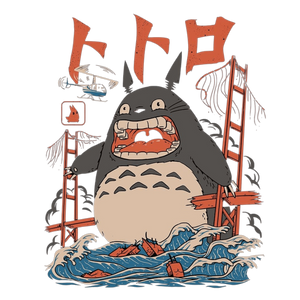
A large gray creature with wide open mouth and visible teeth emerging from stylized blue ocean waves, standing in front of broken orange suspension bridges. The creature has pointed ears, a round cream-colored belly with dark markings, and raised arms. Debris floats in the water below. a small helicopter flies at upper left, and bold orange letters spelling “TRO” appear across the top with additional small graphic symbols. The background is solid black. This artwork is titled “The Neighbors Attack” and created by Vincent Trinidad
The mouth breaks the calm instantly. The creature’s jaw is thrown wide open, teeth rendered as uneven white blocks framing a deep red interior. The mouth stretches vertically, almost rectangular in its openness, giving the figure a startled, roaring presence rather than refined aggression. The eyes sit high and wide, rounded and alert, their placement amplifying the sense of surprise and chaos rather than menace.
The body follows with weight. A massive, rounded torso dominates the center, colored in soft cream with a row of dark, triangular markings across the belly. The gray fur around it is flat and graphic, edged with thick black outlines that keep the form bold and readable. Short arms extend outward, palms turned slightly forward, as if caught mid-motion while rising from the water. The posture feels unsteady but unstoppable — a sudden appearance rather than a calculated entrance.
Your eye drops into the waves. The water is stylized and energetic, layered in bands of blue, teal, and white. Foam crests curl sharply at the edges, echoing classic wave motifs while staying simplified and graphic. Orange fragments — broken beams and debris — bob and tilt within the water, their straight lines contrasting the fluid curves around them. The waves do not engulf the creature; they part around its body, reinforcing scale.
A shift happens when you notice the structures behind. Two large suspension bridges rise on either side, their orange towers snapped and tilted inward. Cables hang loose and tangled, drawn as thin lines that droop and sway visually. The symmetry of the bridges frames the creature, turning destruction into composition. Smoke-like shapes curl behind the towers, dark and minimal, suggesting collapse without overwhelming detail.
Above, the sky is reduced to symbols. A small helicopter hovers at upper left, drawn simply with a rotating blur for its blades, its scale tiny compared to the figure below. Nearby, a small square icon with a rabbit silhouette appears like a stamp or logo, adding an unexpected graphic interruption. Across the top, large orange letters spell “TRO,” cropped and uneven, their rough texture matching the destruction below. Smaller characters and marks scatter nearby, reinforcing the poster-like chaos.
The background remains pure black. There is no horizon, no depth beyond the elements shown. Everything floats in graphic space, forcing focus onto shape, color, and impact rather than realism. The illustration style blends pop-culture homage with bold linework and limited palette, keeping the scene playful even as it depicts collapse.
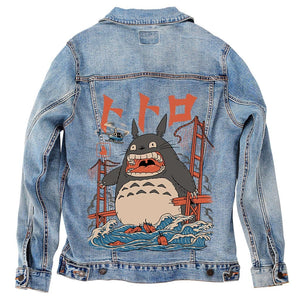
On stonewashed denim, the chaos softens into nostalgia. The orange bridges mute into burnt sienna, and the blue waves blend gently into the fabric grain. Foam edges round, and debris feels embedded rather than floating. The creature’s gray body warms slightly, its belly markings less stark.
The helicopter and lettering fade subtly, feeling like screen-printed remnants rather than sharp icons. Emotionally, the scene shifts from sudden attack to remembered spectacle — destruction as story rather than threat.
Stonewashed denim makes The Neighbors Attack feel like a cult-classic moment replayed over time, its intensity softened by familiarity.
On white denim, clarity takes control. The orange bridges snap into focus, their broken beams and hanging cables sharply defined. The wave layers separate cleanly, and the debris reads instantly as fractured structure. The creature’s facial expression becomes unmistakable — mouth agape, eyes wide, presence dominating the frame.
The “TRO” lettering becomes bold and graphic, anchoring the top of the composition. Emotionally, white denim presents the artwork as loud, playful, and cinematic — a bold visual punch with retro energy.
On black denim, the scene becomes dramatic and immersive. The background disappears entirely, allowing the creature, waves, and bridges to glow forward. Blues deepen, whites brighten, and the orange structures feel hotter and more fractured. The open mouth becomes a dark focal void, pulling the eye inward.
The helicopter feels fragile against the darkness, emphasizing scale and imbalance. Emotionally, black denim transforms The Neighbors Attack into a midnight spectacle — chaotic, humorous, and powerful — where destruction and pop-culture absurdity collide, held tightly against shadow with unapologetic presence.