Seven autumn leaves arranged across open space, each leaf differing in shape, size, and color. The leaves include warm tones of golden yellow, burnt orange, olive green, deep red, muted brown, and soft pink, with visible veins, stems, and speckled grain texture. Some leaves have lobed edges while others are elongated or rounded, and all appear individually separated against a transparent background with no visible ground or color field. This artwork is titled “Fall Leaves” and created by thearticsoul
The leaves float independently, each given room to exist without overlap. Their arrangement feels casual but intentional, like specimens laid out for quiet observation rather than decoration. Shapes vary widely: some leaves are sharply lobed with pointed tips, others rounded and softly scalloped, others elongated with narrow midribs. Each stem curves slightly, suggesting natural drop and release rather than stiffness.
Color defines character. One leaf glows in warm amber and gold, its veins etched lightly through the surface. Another carries deep forest green that fades unevenly toward lighter olive, speckled as if dusted with pollen or soil. A soft pink leaf sits lighter than the others, its pale tone punctuated by thin white veins that read clearly against the pastel surface. Reds range from brick to wine, layered unevenly so darker pigment settles near edges and veins.
Texture is consistent across the set. Fine speckling scatters across every leaf, sometimes dense, sometimes sparse, breaking up flat color and giving each surface a tactile quality. Veins are drawn as thin, deliberate lines, branching outward from central stems and stopping before the edges, reinforcing structure without rigidity. No leaf is pristine; each carries slight irregularity in edge and saturation.
The absence of any background transforms the leaves into pure form and color. There is no tree, no ground, no season implied beyond the palette itself. The composition becomes a study of variation—how many ways a leaf can exist, change, and still belong to the same family. The mood is quiet and observational, held together by restraint rather than narrative.
On stonewashed denim, the leaves soften into memory. Warm yellows and oranges diffuse into the worn twill, and the speckled texture blends naturally with the fabric’s grain. Vein lines lose sharpness, especially in lighter leaves, giving the forms a gently weathered appearance.
The green leaf becomes more muted and earthy on stonewashed denim, its darker tones settling comfortably into the blue-gray base. Reds deepen slightly but lose edge contrast, feeling aged rather than vivid. This matters because the artwork shifts toward familiarity—leaves remembered after they’ve fallen and dried.
Emotionally, stonewashed denim turns Fall Leaves into something reflective. The forms feel worn-in and calm, emphasizing time passing rather than color at its peak.
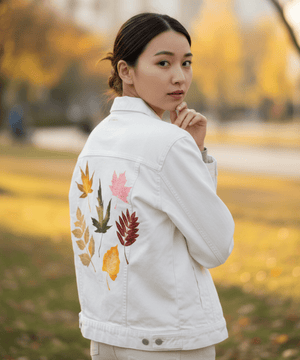
On white denim, clarity returns. Each leaf separates distinctly, and the differences in shape become immediately legible. Veins sharpen, speckling reads as intentional surface detail, and edges feel clean without becoming stiff.
The pink leaf brightens noticeably, standing out with gentle contrast, while yellows and oranges feel fresh and luminous. The green leaf regains depth and structure. This clarity matters because it emphasizes variety—each leaf reads as its own statement within the group.
Emotionally, white denim presents Fall Leaves as bright and present. The artwork feels like a moment captured at full attention, celebrating difference rather than quieting it.
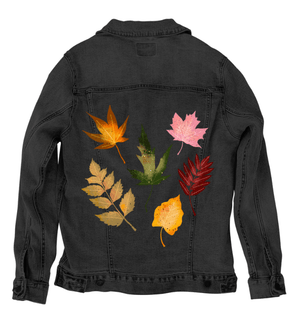
On black denim, the composition compresses and deepens. Lighter leaves glow softly against the dark fabric, while darker reds and greens recede, creating layered depth. Speckling becomes subtler, smoothing surfaces and emphasizing silhouette over detail.
Veins appear through contrast rather than line, and the leaves feel closer together, more intimate. The absence of background becomes more pronounced, turning the leaves into points of color emerging from darkness. This compression creates a hushed, cinematic mood.
On black denim, Fall Leaves feels inward and contemplative. The artwork emphasizes presence through glow and shadow rather than variety.
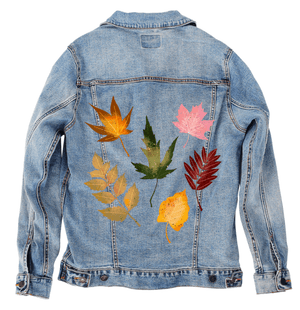
On classic blue denim, balance settles naturally. The indigo ground supports warm and cool tones evenly, allowing yellows and oranges to remain vibrant without overpowering greens and reds. Speckling stays visible but integrated, aligning with the twill texture.
Veins remain legible, and leaf edges feel grounded rather than floating. The composition reads cohesive without becoming uniform. Each leaf maintains its individuality while belonging to the whole.
Emotionally, classic blue denim gives Fall Leaves an everyday steadiness. The artwork feels wearable and familiar, like seasonal change woven into daily life rather than staged for display. This matters because it turns transition into something constant, lived with, and quietly observed.