A
dense repeating woodland pattern on a black background featuring hand-drawn
forest animals including rabbits, deer, foxes, owls, hedgehogs, and squirrels
surrounded by mushrooms, pinecones, ferns, oak leaves, ivy, and white flowers. The
palette uses muted greens, soft browns, creams, pale blush, and gray tones with
fine pencil-like linework and watercolor shading. This artwork is titled “Into
the Woods” and created by Cecilia Battaini
You
drift first into the black — a deep, quiet ground that feels like nightfall
beneath a forest canopy. From it, life rises everywhere at once. Animals,
plants, and mushrooms interlace so completely that there is no empty space,
only rhythm. The pattern does not present a scene; it presents a habitat.
Rabbits
appear upright and alert, their ears tall and slightly angled, outlined with
fine graphite lines that thicken subtly at the base of the neck. Deer stand
delicately on mossy forms, legs slender and still, their pale coats softly
stippled to suggest dappled light. Foxes curl inward, their tails looping like
commas, while owls perch calmly, bodies rounded and eyes forward. Each animal
is rendered with restraint — no exaggeration, no cartoon excess — just enough
detail to feel present.
Between
them, mushrooms rise in varied shapes: some with wide, shallow caps shaded from
warm beige to mushroom brown, others tall and narrow with slender stems that
bend gently. The underside of the caps shows faint gill lines, softened and
never harsh. Fern fronds arc diagonally through the composition, their leaflets
alternating in size, creating visual direction. Oak leaves and ivy overlap,
with veins traced lightly, pigment deepening where leaves intersect.
A
shift in mood happens when you notice how everything touches. Animals rest
against foliage. Mushrooms lean into leaves. White flowers punctuate the darker
greens like pauses in breath. Nothing floats. Everything belongs. This matters
because the pattern feels alive rather than decorative — a living system
instead of isolated motifs.
Texture
carries the emotional pulse. Pencil lines remain visible at edges, especially
around ears, paws, and leaves. Watercolor washes bloom gently inside shapes,
pooling slightly where forms overlap. On denim, these blooms would respond
differently to weave and wear, creating subtle changes over time. The emotional
resonance is belonging, protection, and quiet attentiveness — the
feeling of being held by a place rather than standing within it.
HOW IT WEARS ON DENIM
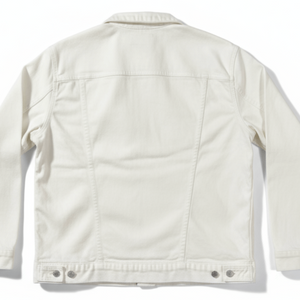
WHITE DENIM
On
white denim, the black woodland background becomes striking and graphic,
sharply defining every animal and botanical element. The pale rabbits, cream
flowers, and light mushrooms stand out clearly, while greens and browns read
clean and illustrative.
As
the jacket moves, fine linework becomes more noticeable — especially fur
outlines and leaf veins. This matters because the pattern feels storybook-like,
almost like a page from a naturalist’s sketchbook. On white denim, the
emotional tone is clarity, wonder, and gentle enchantment.
STONEWASHED DENIM
On
stonewashed denim, the black ground softens into charcoal and deep blue-gray,
allowing the forest palette to blend naturally into the fabric. Greens mellow,
browns warm, and pale animals feel slightly weathered, as if they’ve always
lived there.
Pigment
settles unevenly into the denim’s worn texture, causing some animals and
mushrooms to emerge more strongly than others depending on folds and light.
This matters because the pattern feels lived-in and organic. The emotional
resonance becomes nostalgia, comfort, and rootedness.
BLACK DENIM
On
black denim, the background nearly disappears, and the forest reveals itself
through contrast alone. Pale animals glow softly, white flowers punctuate the
darkness, and mushrooms and leaves surface gradually as the fabric moves.
The
pattern feels secretive here — discovered rather than announced. Animals appear
and vanish with motion, creating a slow, breathing rhythm across the garment.
This matters because the artwork feels intimate and protective. On black denim,
the emotional tone is mystery, stillness, and quiet guardianship.
Across
every base, the truth remains the same:
a forest rendered as a living weave — every creature connected, every detail
intentional, and the wild offered not as spectacle, but as shelter.