Six stylized wildflowers arranged vertically across open space, each with a slender green stem and distinct bloom. From left to right: a small yellow flower with rounded petals and a dark red center; a tall pale blue bell-shaped flower with speckled texture; a soft pink spiky bloom with thin radiating petals; an orange coneflower with drooping petals and a dark rounded center; a thin green stem with a small unopened bud; and a cluster of small blue bell-shaped flowers. All flowers feature visible grain and speckled paint texture on stems and petals. The background is transparent with no visible color field. This artwork is titled “Wildflowers” and created by thearticsoul
The flowers stand separated yet related, each occupying its own vertical column of space. None overlap. Each stem rises independently, slightly curved, with small variations in thickness that suggest hand pressure rather than mechanical precision. The composition breathes because of this spacing; negative space becomes as important as the blooms themselves. The absence of any background color keeps attention locked on form, texture, and rhythm.
On the far left, a small yellow flower opens outward with rounded petals, their edges softly irregular. A dark red cluster sits at the center, built from short, radiating strokes that feel denser than the surrounding color. The stem beneath is thin and olive-toned, textured with grain that grows heavier toward the base. Nearby, a taller pale blue bloom rises like a bell, its petals lightly speckled, fading toward lavender at the edges. The stem is straight but not rigid, slightly tapering as it reaches upward.
At the center, a pink flower bursts outward in fine linear strokes. Its petals are thin, upright, and uneven in length, creating a sense of delicate expansion. The color shifts from pale blush to warmer pink near the base, where the strokes thicken. Below it, a pair of narrow green leaves angle outward, anchoring the bloom visually without symmetry. Just to the right, a tall orange coneflower leans gently, its petals drooping downward around a dark, rounded center that feels weighted and grounded.
The smallest form—a single green stem with a tiny rounded bud—introduces restraint. Its scale is noticeably reduced, its presence quiet. The bud sits slightly off-center, painted with thicker pigment that makes it feel heavier than expected. On the far right, a cluster of blue bell-shaped flowers curves inward, their petals darker at the tips and lighter toward the stems. These blooms feel cooler and calmer, closing the composition softly.
Texture carries the emotional tone. Each petal and stem is filled with visible grain, tiny speckles, and uneven saturation. Color does not sit flat; it gathers, thins, and breaks apart. The flowers feel painted rather than illustrated, tactile rather than graphic. There is no implied field or ground—only individual growth suspended in space.
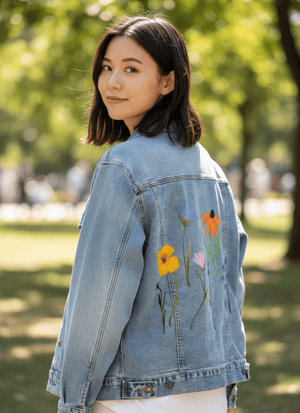
On stonewashed denim, the wildflowers soften into familiarity. The grain of the fabric absorbs the speckled textures, especially in the blue and pink blooms, causing edges to blur gently. The thin stems lose some sharpness, blending into the weave and making the flowers feel weathered and relaxed.
The orange coneflower’s petals become warmer and more muted, their droop emphasized by softened contrast. The tiny bud near the center sinks into the fabric, becoming a quiet detail rather than a focal point. This matters because the composition shifts from botanical clarity to a feeling of memory—flowers recalled rather than freshly observed.
Emotionally, stonewashed denim turns Wildflowers into something lived-in. The blooms feel like traces of a place carried over time, their individuality preserved but gently worn by use.
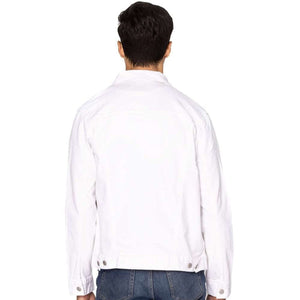
On white denim, clarity blooms. Each flower separates distinctly from the next, and the speckled textures read as intentional surface detail rather than softness. The pale blue and deep blue flowers sharpen noticeably, their edges crisp against the clean fabric.
The pink central bloom feels energetic here, its thin petals clearly separated and upright. The yellow flower’s red center becomes more pronounced, and the green stems read as fresh and clean. This clarity matters because it emphasizes diversity—each wildflower stands confidently on its own.
Emotionally, white denim frames the artwork as celebratory and present. Wildflowers feels bright, open, and declarative, like a field seen in full daylight.
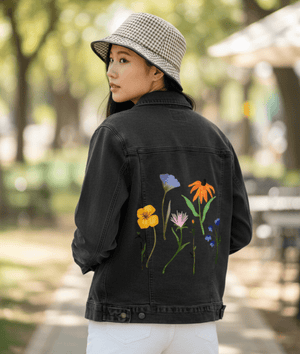
On black denim, the flowers glow inward. Bright petals—especially yellow, orange, and pink—lift off the surface, while darker greens and blues compress into shadow. The stems feel thinner, more fragile, as contrast pulls attention to the blooms.
The blue flowers on the right deepen dramatically, their darker tips nearly dissolving into the background. The central pink bloom becomes luminous, its radiating petals catching light against the dark fabric. This compression creates intimacy; the flowers feel closer, quieter, and more concentrated.
On black denim, Wildflowers becomes contemplative. The composition feels like a collection of small presences emerging from darkness, each bloom a moment of color held briefly in light.
On classic blue denim, balance takes hold. The indigo ground mediates between softness and contrast, allowing colors to remain vivid without becoming stark. The green stems harmonize naturally with the blue fabric, appearing grounded and familiar rather than floating.
The orange coneflower and yellow bloom gain warmth against the blue, their petals feeling sunlit and approachable. The speckled textures remain visible but integrated, sitting comfortably within the twill rather than on top of it. The small bud reads clearly, its scale preserved without disappearing.
Emotionally, classic blue denim gives Wildflowers an everyday presence. The artwork feels wearable and natural, like flowers encountered casually rather than curated. This matters because it reinforces the idea of wild growth—unarranged, resilient, and quietly alive within daily life.