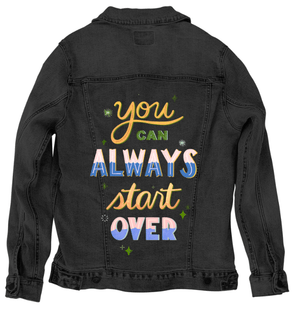
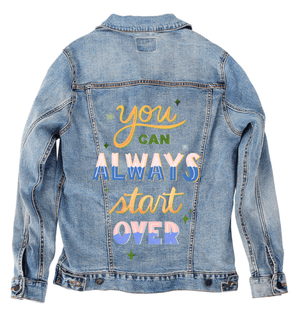
The phrase “you can always start over” arranged in stacked hand-lettered text. the words “you” and “start” are written in flowing cursive script with thick yellow strokes outlined in green. “Can” appears in small block letters filled with green dots. “Always” and “over” are rendered in bold block letters with pastel pink tops and blue lower sections, textured with dots and grain. small starburst and sparkle shapes in green and yellow are scattered around the text. The background is transparent with no visible color field. This artwork is titled “You Can Always Start Over” and created by thearticsoul
The composition rises vertically, each word occupying its own band of space, stacked with intention rather than symmetry. At the top, “you” stretches wide in looping cursive, its thick yellow stroke bending smoothly as if written in a single breath. Fine decorative stitching-like marks run along the interior of the letterforms, adding rhythm and texture without breaking the flow. The green outline hugs the curves closely, reinforcing motion and direction.
Below it, “can” compresses inward. The letters are smaller, blocky, and upright, filled with evenly spaced green dots that create a tactile, almost fabric-like surface. This shift in scale pulls the eye down and pauses the movement briefly before releasing it again. The dotted fill contrasts sharply with the smooth script above, introducing variation through texture rather than color alone.
“Always” expands dramatically across the center. The block letters are tall and confident, their upper halves painted in soft pink tones while the lower halves transition into textured blue, separated by a slightly uneven horizontal edge. The color split feels intentional and physical, like layers stacked rather than blended. Each letter stands firmly, with subtle grain and dot patterns visible within the blue sections.
The word “start” returns to cursive, echoing the opening “you.” Its yellow strokes curve forward with momentum, slightly thicker at the turns and thinner at the exits, suggesting pressure changes as if from a brush or marker. Decorative interior marks repeat, creating continuity across the script elements. Small starbursts and spark shapes float around the letters, spaced irregularly to keep the eye moving.
At the base, “over” anchors the composition. These block letters mirror “always” in construction, with pink upper sections and blue lower sections filled with dotted texture. The letters feel heavier here, visually grounding the message. A small artist signature mark sits beneath, centered and subtle, reinforcing completion without drawing attention away from the text.
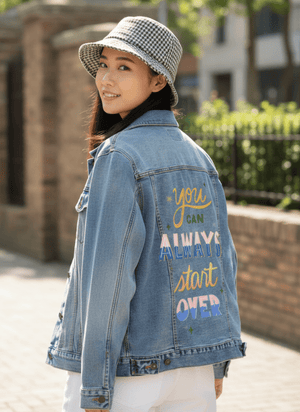
On stonewashed denim, the colors soften and blend gently into the worn twill. The yellow script strokes lose some edge sharpness, especially along tight curves in “you” and “start,” making them feel relaxed and familiar. The dotted textures in “can,” “always,” and “over” diffuse slightly, merging into the fabric grain.
The pink and blue splits soften on stonewashed denim, their boundary becoming less rigid. This reduces contrast and gives the stacked words a unified, aged appearance. The spark and star shapes fade into subtle accents rather than focal points. Emotionally, the piece shifts toward reassurance—less bold declaration, more quiet encouragement.
This matters because the message becomes something lived with rather than announced. On stonewashed denim, You Can Always Start Over feels like advice carried over time, worn into the fabric through repetition and use.
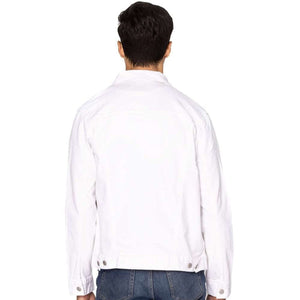
On white denim, clarity takes over. Every letter edge sharpens, and the green outlines around the yellow script become crisp and precise. The dotted textures in “can” and the blue sections of “always” and “over” read clearly as intentional pattern rather than surface noise.
The pink-and-blue divisions become graphic and clean, emphasizing structure and order within the stacked layout. Starbursts and sparkles stand out distinctly, adding playful punctuation around the text. The cursive words feel energetic and expressive, their curves clearly articulated.
Emotionally, white denim turns the piece into a confident statement. The message feels fresh and declarative, framed as possibility rather than reflection. This clarity matters because it presents the artwork as a visible affirmation, meant to be seen and read immediately.
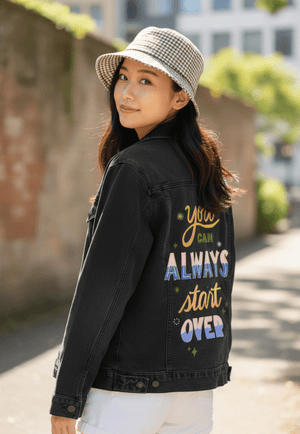
On black denim, the artwork compresses into glow and contrast. The yellow script becomes luminous against the dark fabric, while the green outlines subtly define edges without overpowering the form. The block letters’ pink and blue sections deepen, with dotted textures partially disappearing into shadow.
The stacked words feel closer together on black denim, visually tightening the composition. Spark shapes flicker softly rather than popping, creating a quieter rhythm. The message feels intimate, almost whispered rather than proclaimed.
This compression shifts the emotional tone inward. On black denim, You Can Always Start Over feels personal and reflective, like reassurance offered in a low voice. Color emerges slowly from darkness, reinforcing the idea of renewal happening quietly, from within.